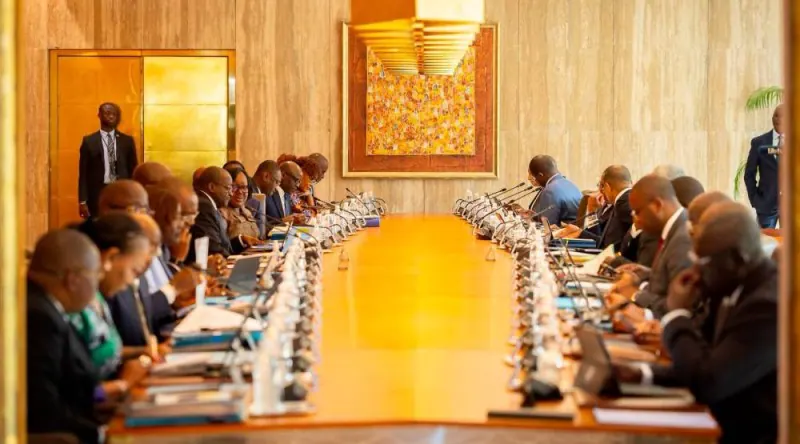
On September 23, 2026, the Council of Ministers of Cote d'Ivoire convened at the Presidential Palace in Abidjan, under the chairmanship of President Alassane Ouattara. The meeting, which lasted from 11:00 AM to 1:30 PM, focused on several key issues. The Council deliberated on various measures, including general measures, draft laws, and ordinances. These discussions aimed to address pressing national concerns and align with international commitments. The Council's decisions are expected to have a significant impact on the country's development and governance.
The Council adopted a draft law modifying the Penal Code, which aims to enhance the country's criminal justice system. This modification, the third since 2019, seeks to align the code with Cote d'Ivoire's international commitments and improve its effectiveness in combating crime. The new law strengthens the protection of minors and women, particularly against sexual violence and deviant behavior. It also introduces harsher penalties for verbal or behavioral abuses targeting administration officials, including village chiefs and kings. Furthermore, the law increases sanctions for environmental offenses, such as illegal gold mining and unauthorized dredging.
In a move to boost the agricultural sector, the Council adopted an ordinance extending regulations on cotton and cashew commercialization to the mango industry. This decision aims to improve the valorization of mango products, which account for around 10% of the country's fruit production. The ordinance amends a 2013 law regulating cotton and cashew activities and expands the mandate of the Coton-Anacarde Council to include mango production. The Council's decision is expected to enhance the competitiveness of Cote d'Ivoire's mango industry and improve the livelihoods of farmers.
The Council also adopted two ordinances and related draft laws to reform the social security system. These ordinances modify the Social Security Code and an existing ordinance on a special retirement bonus for beneficiaries of state-managed pension schemes. The reforms aim to improve the rights of retirees and their dependents, following a series of measures announced by President Ouattara in August 2025. The changes include better pension calculation methods, extended benefits for orphaned children, and increased retirement bonuses. These reforms are expected to ensure the sustainability of the social security system.
In the mining sector, the Council granted a four-year research permit to JOFEMA MINERAL RESOURCES SARL for gold exploration in the Soubré department. The permit was issued in accordance with technical and environmental requirements. This decision is expected to boost investment in the mining sector and contribute to the country's economic growth.
The Council also adopted a decree reorganizing the Institute of Communication Sciences and Techniques (ISTC). This decree aligns the ISTC's structure and functioning with a new law on national public establishments adopted in August 2020. The reorganization includes the creation of two new schools: the School of Organizational Communication and Development. This restructuring aims to enhance the competitiveness of the institute and address the needs of the audiovisual sector.
The Council's decisions are expected to have a positive impact on Cote d'Ivoire's development, governance, and economy. The new laws and regulations adopted aim to improve the business environment, enhance social security, and protect the environment. The Council's meeting demonstrates the government's commitment to implementing reforms and improving the lives of Cote d'Ivoire's citizens.
Key points
- The Council adopted a draft law modifying the Penal Code to align with international commitments and improve crime combat.
- An ordinance was adopted to extend regulations on cotton and cashew commercialization to the mango industry.
- The Council granted a four-year research permit to JOFEMA MINERAL RESOURCES SARL for gold exploration.