The 9th Summer University of the Tunisian Association of Financial and Commercial Law (ATCF) emphasized that Tunisia's banking sector transformation cannot be limited to surface-level digitalization. To meet the requirements of the 2026-2030 Development Plan, financial institutions must develop real capabilities to convert technology into operational efficiency, data into strategic decisions, and innovation into economic sovereignty. This was stated by Abdelwaheb Ben Moussa, an expert in the field.
The current state of the banking sector's information systems, specifically the Core Banking Systems, is a major bottleneck. These systems were designed in an era when banks operated in isolation and have accumulated significant technical debt. Each regulatory or commercial change requires complex, costly, and time-consuming developments that are incompatible with the pace of the digital economy. Therefore, experts suggest adopting an API-first architecture to modernize the Core Banking system without compromising stability.
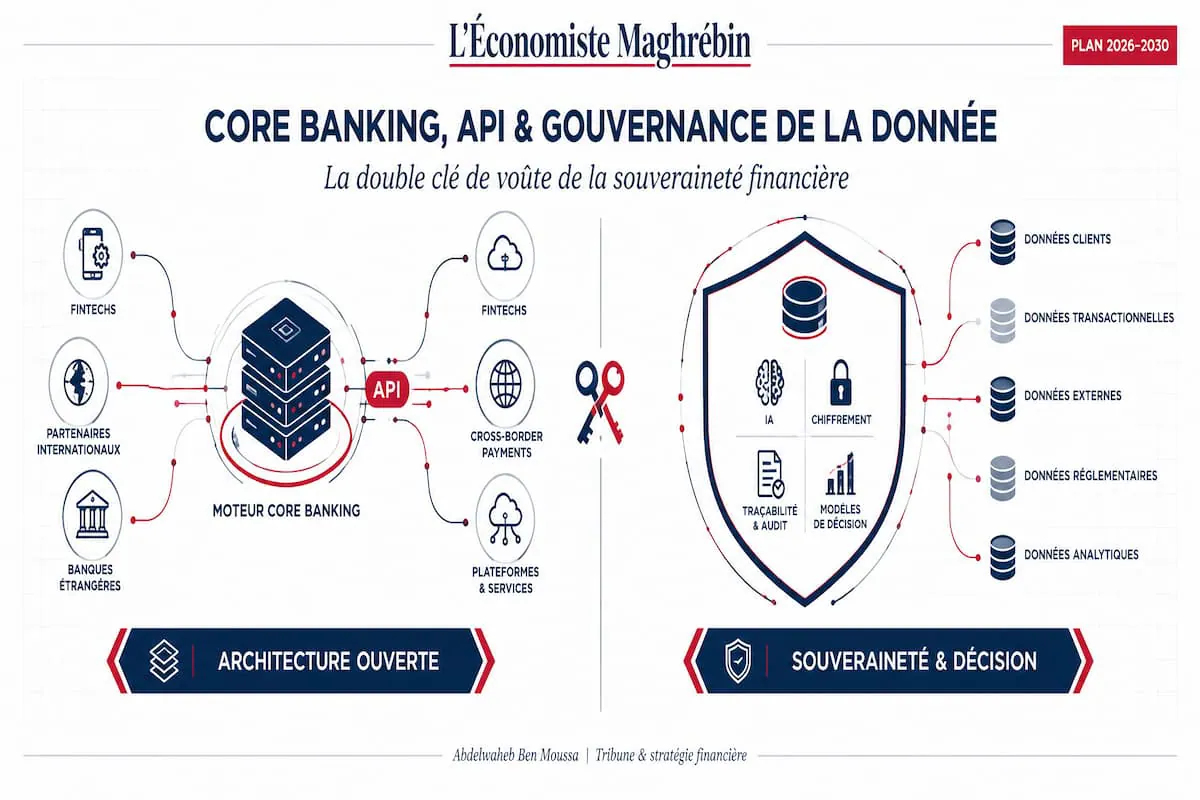
The API-first architecture provides a layer of decoupling and secure encapsulation, isolating the core business behind controlled gateways. This allows for progressive and modular modernization without compromising the stability of the accounting nucleus. The open architecture enables dialogue between the banking system and FinTechs, cross-border payment platforms, and African trade networks. It transforms a closed infrastructure bank into a fluid intermediation platform capable of irrigating the real economy without breaking control chains.
The second major project concerns the nature of information produced by banks. Financial data has long been treated passively as accounting proof and a posteriori control. However, experts argue that well-governed financial data can become a strategic sovereign asset and a compliance lever. To achieve this, three fundamental requirements must be met: reconciliation and traceability to the source, mastery of the Cloud and sovereignty, and governance of artificial intelligence.
The governance of financial data requires a model of scoring, credit, or risk detection that is only valid if its inputs are reliable. Fragmented or unreconciled data generate opacity that paralyzes decision-making and multiplies false alerts of non-compliance. The Cloud and sovereignty mastery require a hybrid architecture that guarantees the absolute independence of the establishment facing technology giants. Finally, the governance of artificial intelligence requires the integration of advanced analysis models and decision-making tools that produce real value only if accompanied by algorithm explicability.
The technical infrastructure is the foundation of economic sovereignty. One cannot pilot a regional integration strategy or a five-year development plan with cloistered information flows and non-auditable databases. Open architectures and data governance are not purely technical subjects abandoned to IT departments alone, nor are they passive expenditure items. They are instruments of economic policy that require a maturity leap for the 2026-2030 cycle.
Modernizing the core of its systems through decoupling and sanctuarizing its data heritage will enable the banking sector to give substance to its transformation and build the sovereign infrastructure of the economy of tomorrow. The cycle 2026-2030 requires this maturity leap. Experts stress that it is essential to focus on these two pillars of engineering renovation: the opening of central computer architectures by APIs and the sanctuarization of financial data as a national strategic asset.
Key points
- API-first architecture can modernize the Core Banking system without compromising stability.
- Well-governed financial data can become a strategic sovereign asset and a compliance lever.
- Open architectures and data governance are instruments of economic policy that require a maturity leap for the 2026-2030 cycle.