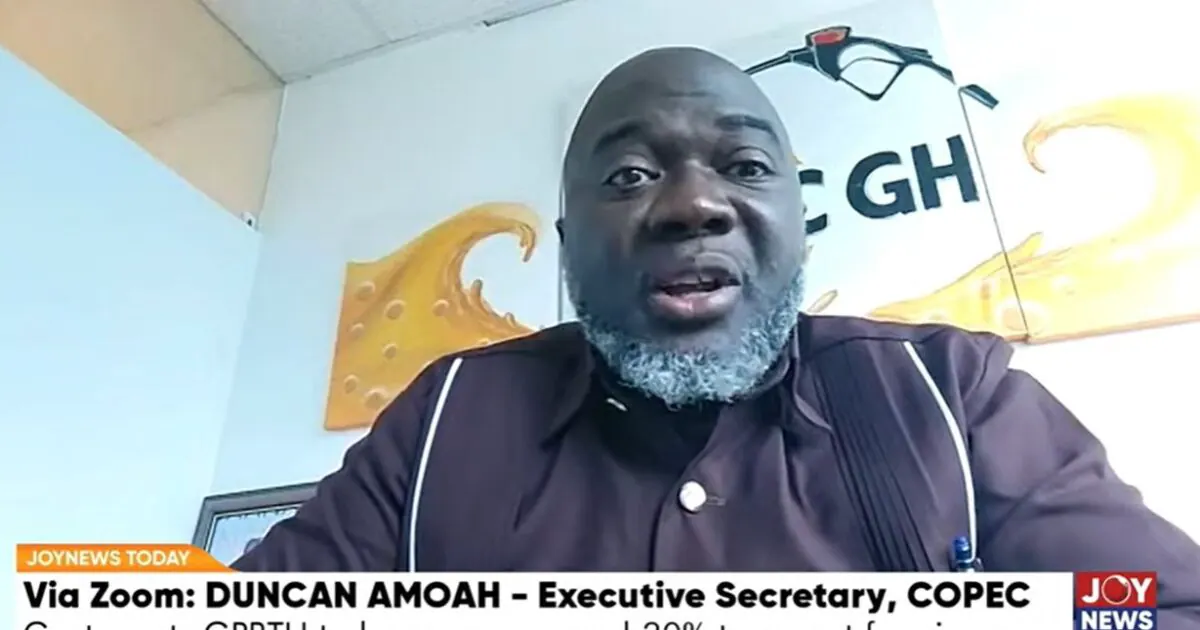
The Executive Director of the Chamber of Petroleum Consumers (COPEC), Duncan Amoah, has stated that some increase in transport fares may be justified due to rising fuel and maintenance costs. He noted that the government's GH¢2 per litre intervention on diesel has helped sustain fuel prices for transport operators but has not fully offset the rising cost of operations. This comes as the Ghana Private Road Transport Union (GPRTU) has been engaging stakeholders for several months over its request for a fare adjustment.
According to Amoah, given the financial pressures facing commercial drivers, "it is only fair that some amount of increase be allowed to the driving community." He expects the ongoing discussions between the GPRTU and government to result in a lower adjustment than the 30% increase initially proposed by the union. Amoah suggests that a 15-20% increase might be a possible outcome by the close of the engagement.
Amoah acknowledged that any increase in transport fares would ultimately affect commuters, whose incomes have largely remained unchanged. He stressed that "the end payer is going to bear the brunt because salaries have not been increased." This highlights the need for a broader consideration of workers' incomes, with organised labour playing a role in negotiating possible adjustments to salaries.
To address this issue, Amoah proposed that the GPRTU and the Transport Ministry develop a cost-per-kilometre and cost-per-passenger model. This system would allow fares to be calculated objectively based on factors such as distance, fuel consumption, vehicle maintenance, and passenger numbers, rather than being determined through negotiations alone.
The GPRTU's request for a fare adjustment is driven by the rising cost of operations, including fuel and maintenance costs. The union has been engaging stakeholders for several months to find a solution. Amoah's comments suggest that a fare increase may be inevitable, but the extent of the increase remains to be determined.
Amoah's proposal for a scientific approach to determining transport fares is aimed at ensuring that fares are calculated fairly and transparently. He believes that this approach would help to reduce the impact of fare increases on commuters and ensure that transport operators are able to cover their costs.
The issue of transport fares is a complex one, with implications for both transport operators and commuters. As discussions between the GPRTU and government continue, stakeholders will be watching closely to see how the issue is resolved. A key consideration will be the impact of any fare increase on commuters, who are already facing financial pressures.
Key points
- COPEC supports a possible transport fare increase due to rising fuel and maintenance costs.
- The impact of any fare increase on commuters with unchanged incomes is a major concern.
- A scientific approach to determining transport fares could help to reduce the impact of fare increases on commuters.