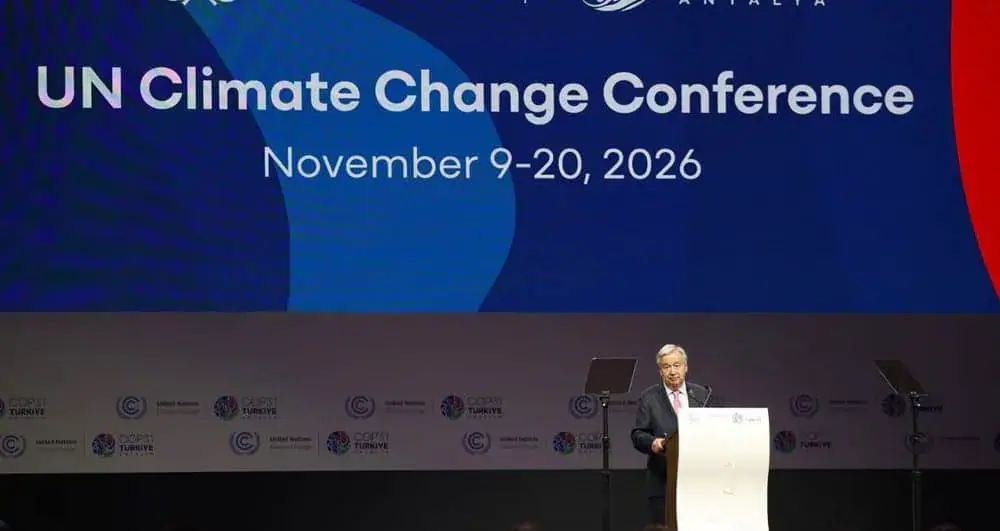
The 31st United Nations Climate Change Conference, COP31, began its high-level opening in Antalya, Turkey, with a stark warning from UN Secretary-General António Guterres that the planet is on a "path of mutual destruction." The conference, co-chaired by Turkey and Australia, seeks to accelerate climate financing, energy transition, and protection of vulnerable communities. Guterres emphasized that the fossil fuel industry continues to profit at the expense of the planet, with intense disasters affecting lives, livelihoods, and economies worldwide.
Guterres highlighted the exponential growth of renewable energy over the past decade, with solar energy increasing from 1% of global electricity to covering nearly 75% of demand growth last year. Electric vehicle sales have also surged, with one in three vehicles sold being electric. Renewable sources are now the cheapest option for expanding the electricity matrix in most parts of the world. However, despite this progress, global emissions reached a record high in 2025, according to the UN chief.
Brazilian President Luiz Inácio Lula da Silva, representing one of the Portuguese-speaking countries, emphasized that climate change is losing ground on the international agenda, overshadowed by wars and trade disputes. Lula stressed the need for international cooperation, particularly in the face of growing attacks on climate science and multilateralism. He announced that Brazil will develop national action plans to reduce its dependence on fossil fuels and achieve zero deforestation, building on the work of last year's COP30 in the Amazon.
The fragility of the fossil fuel model was another key point raised, with Guterres warning that it must be phased out, like the dinosaurs. The transition to clean energy is crucial for economic stability and national security. However, the pace of change remains slow, with emissions needing to fall by around 6% annually to limit warming to 1.5°C. Current national targets offer only a third of this reduction, highlighting the need for more ambitious action.
The economic costs of dependence on fossil fuels were also highlighted, with UN Climate Executive Secretary Simon Stiell warning of "relentless economic costs." In contrast, clean energy can serve as a shield against inflation. COP31 President Murat Kurum launched the "35-by-35" global commitment to increase the share of electricity in the energy mix from 23% to 35% by 2035. This move aims to reduce the vulnerability of importing countries to price shocks and geopolitical crises.
The impact of the climate crisis on human health and food security dominated discussions, with the World Health Organization (WHO) warning that over 3.3 billion people live in areas of extremely high risk. The heat is already affecting maternal health and overburdening hospital systems. In response, the Antalya Initiative for Health Resilience was launched, integrating weather forecasts into preventive planning in hospitals. The focus is also on supporting family farmers, who are severely affected by droughts, such as the emergency declared in Bolivia.
To address these challenges, there is a push to streamline international funding to reach local producers directly before disasters strike. The goal is to make funding more accessible and effective in supporting those most vulnerable to climate change. As COP31 continues, countries are expected to work towards concrete agreements to accelerate the transition to clean energy and protect communities from the intensifying impacts of climate change.
Key points
- COP31 aims to increase electricity share in energy mix to 35% by 2035
- Global emissions reached record high in 2025 despite growth in renewable energy
- Climate crisis affects health and food security of 3.3 billion people worldwide