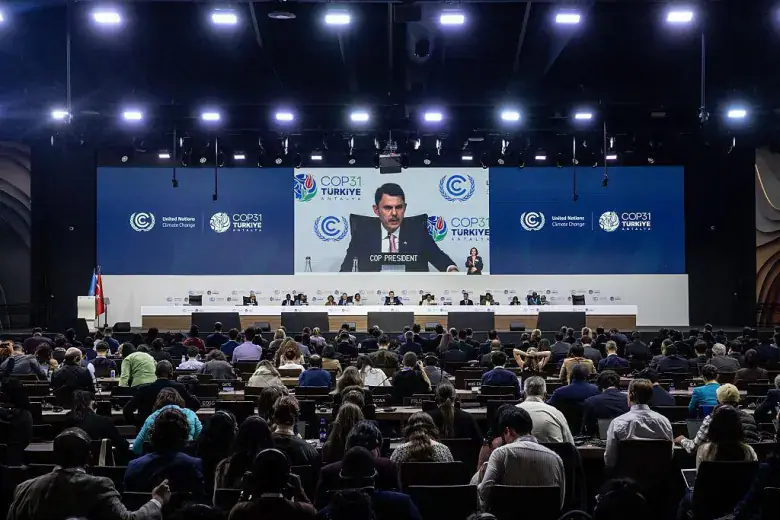
The United Nations climate conference in Antalya, Türkiye, concluded without a comprehensive agreement on its proposed overarching political deal. The failure to adopt the proposed Antalya Pact was due to deep divisions over fossil fuels, climate finance, and global climate action. The conference did, however, result in separate decisions on issues including the Global Goal on Adaptation and the Just Transition Work Programme.
The proposed Antalya Pact consisted of two Presidency-led decisions, one under the United Nations climate convention and another under the Paris Agreement. The pact aimed to provide a political response to the climate crisis and set direction for the next phase of international climate action. However, countries could not agree on the language, particularly regarding the transition away from fossil fuels and climate finance for developing countries.
A central dispute was whether the decisions should explicitly address the transition away from fossil fuels, the main source of greenhouse gas emissions. The European Union insisted that any agreement must mention fossil fuels, while Russia opposed language on fossil fuels, warning of potential price shocks and energy shortages. Saudi Arabia argued that all proposed solutions should remain available.
The disagreement left governments unable to reach the consensus required to adopt the two decisions. The dispute was not simply about whether fossil fuels should be mentioned, but also about whether the conference would reaffirm commitments made at previous summits or weaken them through a new political text. More than 130 countries had called for stronger action on transitioning away from fossil fuels.
Despite the lack of agreement on the Antalya Pact, the conference produced decisions in areas where governments were able to reach agreement. One of the most significant was the Global Goal on Adaptation, which seeks to measure whether countries are becoming better able to cope with the effects of climate change. Governments agreed to establish a technical task force to refine indicators and develop guidance for their use by October 2027.
Another decision was reached on the Just Transition Work Programme, which was extended for three years. The program provides a space for countries to discuss how the shift to lower-emission economies can protect workers, communities, and people whose livelihoods depend on industries affected by climate policies. However, governments did not settle the operational arrangements for the Just Transition Mechanism agreed at COP30.
The failure of COP31 to reach an agreement on key climate issues has significant implications for countries such as Liberia, where coastal erosion, flooding, extreme heat, and pressure on agriculture require investments in infrastructure, public services, and community protection. Attention now turns to Ethiopia’s hosting of COP32 in 2027, where countries will revisit the issues that were left unresolved in Antalya.
Key points
- The conference failed to adopt the proposed Antalya Pact due to disagreements over fossil fuels and climate finance.
- Governments adopted separate decisions on the Global Goal on Adaptation and the Just Transition Work Programme.
- The disputes at COP31 exposed the difficulty of reaching consensus when countries have competing priorities over climate action, financing, and responsibility.