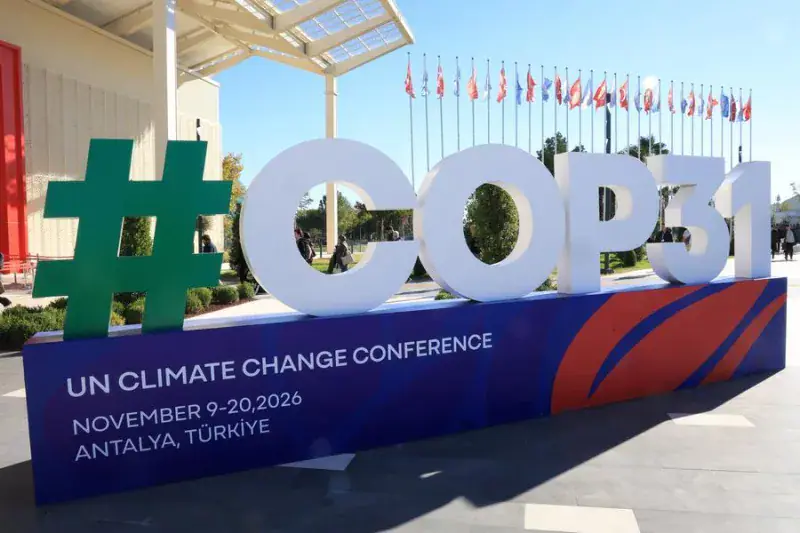
The recent COP31 climate summit in Antalya, Turkey, ended in failure, with countries unable to agree on a joint statement due to disagreements over the mention of fossil fuels. The proposed Antalya Pact did not include language on fossil fuels, which some countries saw as a significant step back from previous agreements. The collapse of the talks has highlighted the deep divisions between countries on the issue of climate action.
The negotiations were led by Australian Minister Chris Bowen, who described the geopolitical environment as "the most complicated and fraught in living memory". The talks were marked by competing demands and "unbridgeable red lines", with some countries refusing to agree to a statement that did not explicitly commit to moving away from fossil fuels. Turkey's Environment Minister Murat Kurum expressed frustration that governments were unable to find common ground, saying they should not disappoint people desperate for climate action.
The disagreement over fossil fuels was driven in part by concerns about energy security and economic development. Saudi negotiator Mohammad Ayoub argued that Arab countries had contributed less than 2% of historical greenhouse gas emissions and should be allowed to choose their own path on climate action. Russia's Sergei Kononuchenko went further, warning that cutting oil and gas supplies would cause shortages and energy poverty.
The absence of a US delegation at the talks, due to President Donald Trump's rejection of the international climate process, was also seen as significant. Meanwhile, a joint declaration by Trump, China's President Xi Jinping, and Russia's Vladimir Putin included a pledge to increase production and supply of refined petroleum products, highlighting the different priorities of some of the world's most powerful governments.
Despite the failure of the talks, a substantial majority of governments - around 130 countries - had backed a demand for explicit language on moving away from fossil fuels. Christiana Figueres, who led the UN negotiations that delivered the Paris Agreement, argued that countries were right to walk away rather than endorse a weaker commitment that might undermine progress.
The dispute over climate finance also played a significant role in the collapse of the talks. Russia's Kononuchenko complained that much of the money provided by wealthy countries to poorer nations came as loans rather than grants, leaving developing countries with significant debt. This complaint was echoed by Mohamed Adow, a Kenyan campaigner, who accused Europe of rejecting a flawed deal while refusing to acknowledge its own responsibility for the failure on finance.
The failure of COP31 does not mean that climate action will stop. The energy transition is moving forward, driven by the increasing competitiveness of solar panels, batteries, and electric vehicles. However, the slow pace of progress remains a concern, and the need for more ambitious action is clear. The UN climate chief, Simon Stiell, has acknowledged the need to "improve, modernise and reform" the process, but finding a way forward that works for all countries will be a significant challenge.
Key points
- The collapse of COP31 highlights deep divisions between countries on climate action.
- A substantial majority of governments had backed a demand for explicit language on moving away from fossil fuels.
- The dispute over climate finance was a significant factor in the failure of the talks.