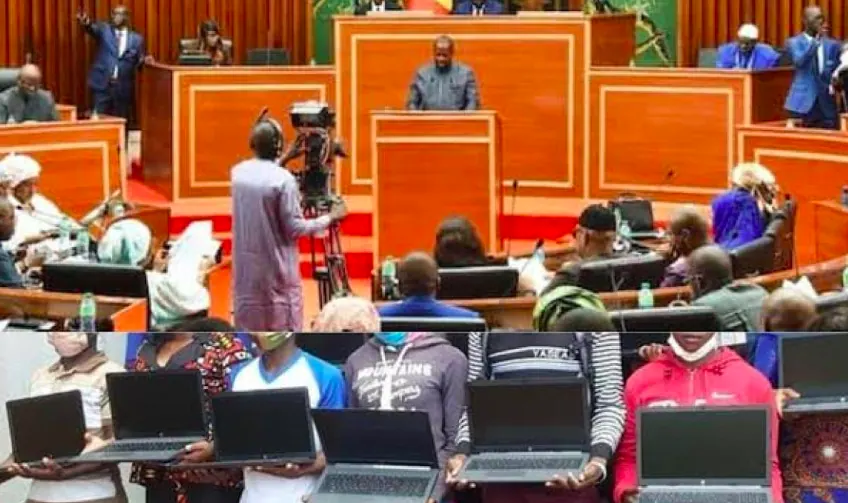
The Senegalese parliament's commission of inquiry into the "One Student, One Computer" program has begun its hearings, with four high-ranking officials and former executives from the Ministry of Higher Education, Research, and Innovation (MESRI) testifying. The inquiry has uncovered a troubling lack of communication between administrative departments and raised questions about the program's procurement process. According to testimony, Mountaga Dia, former coordinator of the Cellule de passation des marchés, and Abou Kadri Diatta, president of the Commission de passation des marchés, were not involved in the program's initial planning.
The officials testified that they were not informed about the program's allocation of 250,000 FCFA to students. Inspector of Administrative and Financial Affairs, Cheikh Diop, appointed in 2026, stated that he only learned about the program during an investigation ordered by the minister. Meanwhile, Saliou Abdoulaye Ngom, Director of General Administration and Equipment (DAGE), claimed that his department was only responsible for disbursing financial allocations to students, without knowledge of the program's overall scope.
The live broadcast of the hearings has sparked a heated debate among jurists and parliamentarians. Babacar Gaye, a former deputy, has denounced the live broadcast, citing the Assembly's internal regulations, which require committee hearings to be held in private to protect individual freedoms and secrets protected by law. In contrast, Senghane Senghor, president of the Convergence africaine pour la démocratie et les droits humains, has welcomed the transparency but expressed concerns about procedural irregularities.
The "One Student, One Computer" program has been marred by controversy since its inception. The program aimed to provide computers to students, but allegations of irregularities in the procurement process have led to a parliamentary inquiry. The commission's hearings are expected to shed light on the program's management and identify those responsible for any wrongdoing.
The inquiry has also revealed a lack of coordination between different administrative departments. The testimony of the MESRI officials has highlighted a disconnect between the department responsible for procurement and those responsible for implementing the program. This lack of communication has raised questions about the program's effectiveness and the use of public funds.
The controversy surrounding the live broadcast of the hearings has sparked a wider debate about transparency and accountability in Senegal's parliament. While some have welcomed the transparency, others have expressed concerns about the potential risks of live broadcasting committee hearings. The debate is expected to continue as the inquiry unfolds.
The parliamentary commission's inquiry into the "One Student, One Computer" program is ongoing, with further testimony expected from other officials and stakeholders. The inquiry's findings are likely to have significant implications for the program's future and the management of public funds in Senegal.
Key points
- The live broadcast of the hearings has sparked controversy over the balance between transparency and the protection of individual freedoms and secrets protected by law.