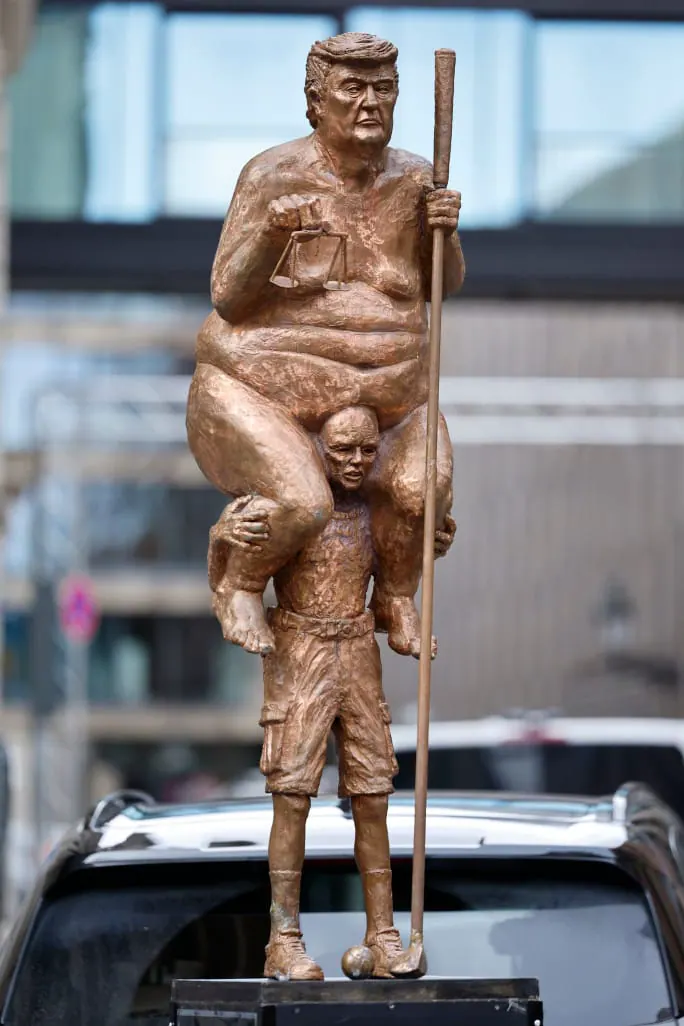
A striking sculpture of former US President Donald Trump has been put on display in the European Parliament building in Strasbourg, France. The artwork, titled "The Orange Plague" or "King of Injustice," depicts Trump naked, sitting on the back of a smaller person, and has sparked controversy and debate about the intersection of art and politics. The sculpture, created by Danish artist Jens Galschiøt, is approximately 2.5 meters tall, including its base, and is covered in gold.
Galschiøt, known for his thought-provoking and often provocative artworks, aims to highlight pressing global issues, including democracy, climate change, and social justice. The sculpture is meant to convey a powerful message about the state of global governance and the need for accountability. According to the artist, Trump represents one of the key figures responsible for the challenges he seeks to address on a global scale.
The sculpture was unveiled at the European Parliament at the invitation of Danish Member of the European Parliament, Per Clausen. Clausen argued that the European Parliament is a suitable venue for discussing pressing global issues and that art should be used to stimulate debate and conversation about politics. He emphasized that avoiding such discussions out of fear of offending certain individuals would be a sign of cowardice.
Galschiøt's artwork has been displayed in various international settings, including a climate conference in Brazil and other global events. The artist plans to showcase the sculpture again at COP31 in Turkey in November 2026. His previous works include "The Pillar of Shame," a sculpture commemorating the victims of the Tiananmen Square crackdown in 1989, and "The Survival of the Fattest," which critiques social inequality.
The display of "The Orange Plague" in Strasbourg has sparked a range of reactions, with some viewing it as a legitimate form of artistic expression and others seeing it as an attack on Trump's person. The sculpture has prompted discussions about the boundaries between artistic freedom, political satire, and respect for public figures. While some see it as a justified critique of Trump's policies, others argue that it crosses a line into ridicule and disrespect.
The controversy surrounding the sculpture has also raised questions about the role of art in holding those in power accountable and stimulating public debate about pressing global issues. Galschiøt's work often seeks to challenge social norms and spark conversations about uncomfortable topics. As the sculpture continues to attract attention and spark debate, it remains to be seen how it will be received by the public and policymakers in the coming months.
The sculpture's message extends beyond Trump, representing a broader commentary on power dynamics, inequality, and the need for collective action to address global challenges. As such, "The Orange Plague" has become a focal point for discussions about the intersection of art, politics, and social responsibility, highlighting the ongoing relevance of Galschiøt's work in contemporary public discourse.
Key points
- The sculpture is a critique of Trump's policies and a commentary on global governance, democracy, and climate change.
- The artwork has sparked debate about the role of art in politics and the limits of free expression.
- The sculpture will be displayed again at COP31 in Turkey in November 2026.