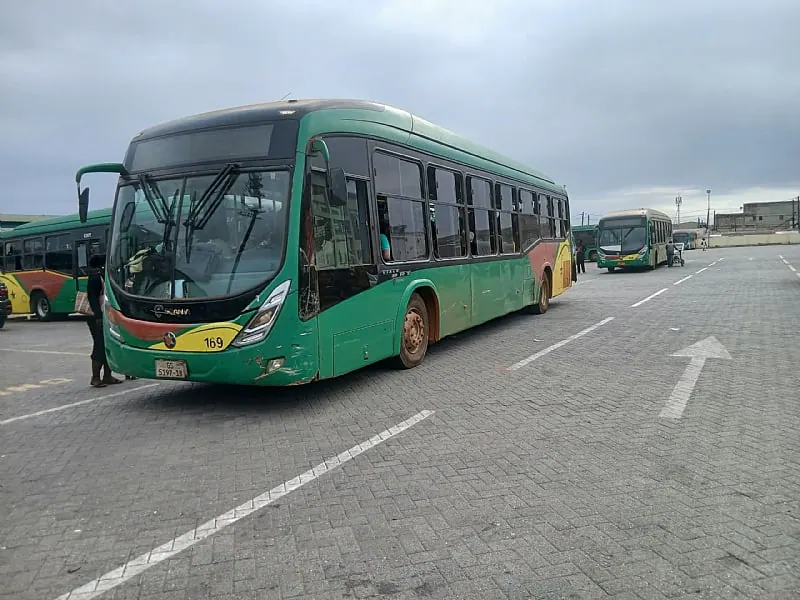
The Greater Accra Passenger Transport Executive (GAPTE) has reported a significant improvement in travel time on the Adenta-Accra corridor following the introduction of a contra-flow arrangement for Ayalolo Bus Rapid Transit (BRT) services. This initiative, implemented on September 29, 2026, aims to reduce congestion and travel time during peak hours. According to GAPTE's Managing Director, Mr. Awudu Dawuda, the contra-flow arrangement has successfully reduced travel time from Adenta to Accra.
Prior to the implementation of the contra-flow arrangement, a journey from Adenta to Accra during peak hours typically took about two-and-a-half hours. However, on the first day of implementation, commuters completed the journey in just 23 minutes during the morning session. Mr. Dawuda expressed confidence that evening peak hour commutes could also be completed within approximately 23 to 25 minutes. This significant reduction in travel time is expected to improve the overall commuting experience for residents.
On the first day of implementation, the contra-flow arrangement transported about 8,000 passengers from Adenta towards Accra during the morning session. This demonstrates the capacity of the intervention to efficiently move large numbers of commuters. Mr. Dawuda emphasized that GAPTE's focus is on moving people, not buses, and that the Executive's responsibility is to respond to passenger demands at locations where large numbers of commuters need transportation.
The contra-flow arrangement, which covers the Amasaman-Accra, Adenta-Accra, and Kasoa-Accra corridors, operates during peak hours from 0600 hours to 0900 hours and 1600 hours to 2000 hours. Selected sections are temporarily configured to allow authorized Ayalolo buses to travel against the normal flow of traffic in the priority direction. This initiative is being implemented in collaboration with the Motor Traffic and Transport Department (MTTD) of the Ghana Police Service and the Department of Urban Roads.
The MTTD is providing traffic control and enforcement support at strategic locations and major intersections along the affected corridors. Designated lanes are strictly reserved for Ayalolo buses, with private vehicles, taxis, trotros, and other unauthorized road users prohibited from using them. GAPTE has also undertaken public sensitization on the new arrangement and urged the media to assist in educating commuters and other road users on the initiative.
According to Mr. Dawuda, cooperation from short-haul drivers and private road users has been positive on the first day of implementation. However, operational and safety challenges are expected to emerge, and GAPTE will address them as they arise. The Managing Director urged the public to embrace the arrangement, stating that "it has come to stay" and that it has already reduced passenger congestion at some points along the Adenta corridor.
The successful implementation of the contra-flow arrangement is a significant step towards easing congestion in Greater Accra. As the first time such an intervention has been implemented as a traffic management principle, GAPTE is optimistic about its potential to improve the commuting experience for residents. With continued cooperation from commuters and road users, the contra-flow arrangement is expected to achieve its goals of reducing travel time and congestion on the Adenta-Accra corridor.
Key points
- The contra-flow arrangement has reduced Adenta-Accra travel time to 23 minutes.
- The initiative has transported about 8,000 passengers on its first day of implementation.
- The arrangement operates during peak hours, with designated lanes reserved for Ayalolo buses.