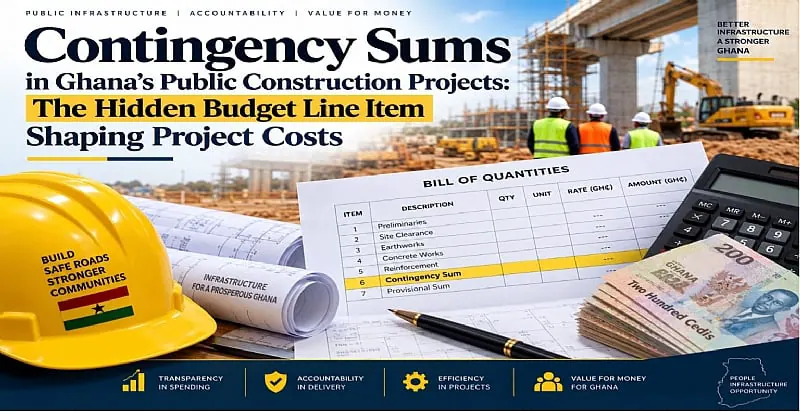
A little-known line item in Ghana's public construction projects, known as contingency sums, has become a contentious issue. Buried deep in the Bill of Quantities, this item usually accounts for 5-10% of the total project cost. Despite its significance, there is confusion over what it is used for and who has the authority to spend it. This lack of clarity has led to disputes over how public money is handled in Ghana's construction projects.
The contingency sum is added to the project cost after subtracting specified provisional sums. For example, in a road rehabilitation project in the Upper West Region, the sub-total of nine bills of works was GH₵130,987,475. After subtracting GH₵1,190,000 in provisional sums, a 10% physical contingency and 10% financial contingency were applied, adding GH₵12,979,747.50 to the contract sum. This brought the total contract sum to GH₵143,967,222.50.
The issue of contingency sums has significant implications for project financing. In Ghana, the standard tender documents provide for a mobilization advance to be paid to contractors before work begins. However, there is confusion over whether the contingency sum should be included in the calculation of this advance. If it is included, the contractor may receive more money than needed, while excluding it may leave the contractor underfunded.
A survey of construction-sector practitioners revealed a lack of consistency in how contingency sums are treated when calculating mobilization advances. Some institutions include the contingency allowance in the advance-payment base, while others exclude it or have no clear practice. This inconsistency raises questions about financial prudence and the proper interpretation of tender documents.
The stakes are high, with significant sums of money involved. For a representative GH₵50 million road contract with a 15% mobilization advance rate and a 10% contingency allowance, the advance payment could be GH₵7.5 million if the contingency is included or GH₵6.75 million if it is excluded. This gap of GH₵750,000 highlights the need for clarity on the issue.
Two opposing views have emerged on the issue. A project manager argues that including contingency in the advance payment is necessary to fund the contractor's mobilization costs, while a senior QS/Procurement officer counters that advancing money against costs that may never materialize leaves the state exposed. The officer's argument is based on financial prudence, risk allocation, and contract logic.
The Ghanaian Auditor-General has flagged this governance gap, which costs the public purse real money. The emerging Value for Money Office has the mandate and opportunity to close this gap. The issue of contingency sums highlights the need for greater transparency and accountability in Ghana's public construction projects.
Key points
- The contingency sum is a significant line item in Ghana's public construction projects, accounting for 5-10% of the total project cost.
- There is a lack of consistency in how contingency sums are treated when calculating mobilization advances.
- The issue of contingency sums has significant implications for project financing and the proper interpretation of tender documents.