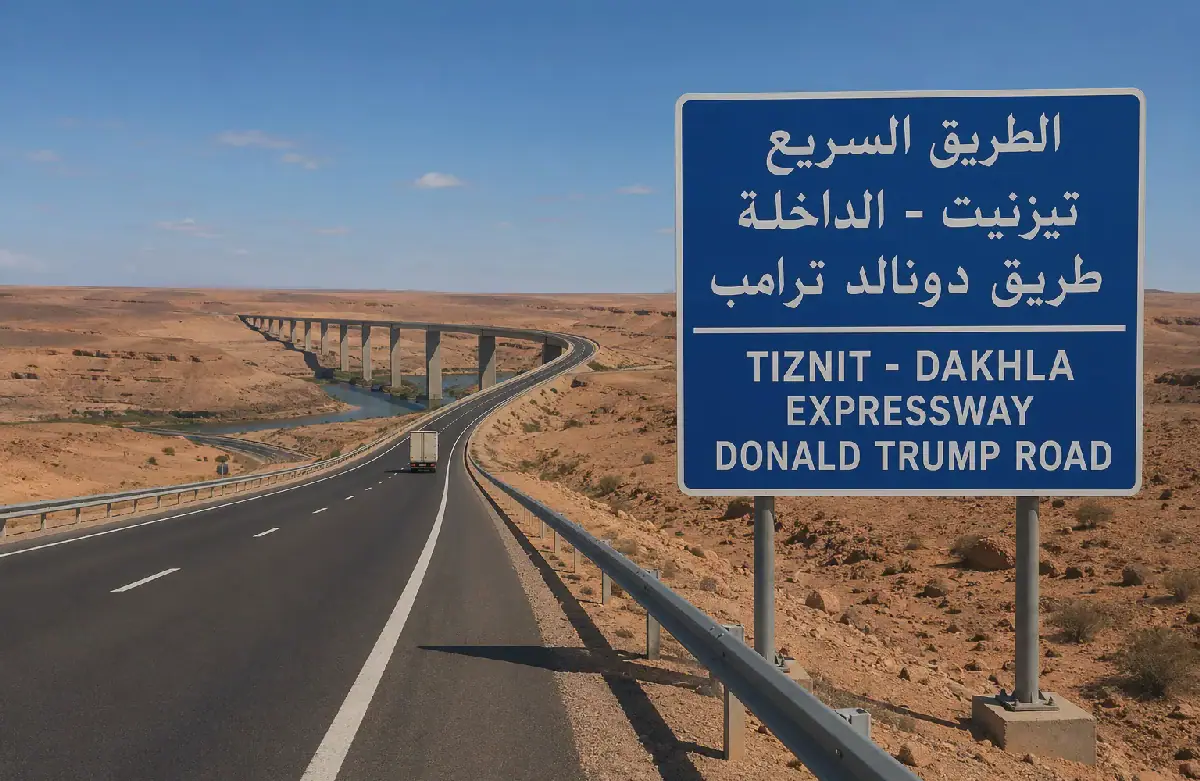
The construction of the road bridge over Wadi Sakaia Al-Hamra in Laayoune, Morocco, is progressing at a rapid pace, with a completion rate of over 57%. The project, which is part of the Tiznit-Dakhla highway, aims to strengthen the connection with the southern regions and enhance trade exchanges between Morocco and its African depth. The bridge, which is the longest road bridge in Morocco, has a total length of 1,648 meters and a width of 21.4 meters.
The Tiznit-Dakhla highway project, which spans 1,055 km, has a total budget of over 9 billion dirhams and includes 16 major engineering structures, including the Wadi Sakaia Al-Hamra bridge. The bridge alone has a budget of 1.375 billion dirhams. The project is supervised by the Ministry of Equipment and Water and uses a structure made of prestressed concrete, built using the balanced cantilever technique.
The bridge's structure is based on 14 piers, with some reaching a height of 46.5 meters, while the deep foundations extend 24 to 46 meters into the ground. The massive project requires significant amounts of materials, including 70,000 cubic meters of concrete and 12,000 tons of steel. The project's central manager, Mbarak Fench, highlighted the strategic importance of the bridge, which is part of the development program for the southern regions.
The bridge will play a crucial role in improving road safety, traffic flow, and attracting investments, ultimately enhancing the living conditions of residents and promoting economic opportunities in the regions it passes through. The project's completion is expected to facilitate the movement of people and goods between the north and south, reducing traffic pressure in urban areas and improving road safety.
The construction process involves around 900 workers, divided into three teams, working around the clock to ensure the project's timely completion. The current phase of the project requires precise engineering and monitoring to ensure the structure's quality and durability. The project's team must consider the region's climatic and environmental conditions, including high temperatures, salinity, and winds, from the design stage.
The project's environmental impact is also a significant consideration, given the ecological value of Wadi Sakaia Al-Hamra, which was classified as a Ramsar site in April 2019. The area is a vital stopover for migratory birds and a habitat for several plant and animal species, including the pink flamingo and the marbled duck, which are globally threatened species. Measures are being taken to minimize the project's impact on the local ecosystem during the construction phase.
Once completed, the bridge is expected to enhance the attractiveness of Laayoune city and support its urban development while preserving its environment. The project is part of a broader vision to modernize the infrastructure of the southern regions, promote their socio-economic development, and consolidate their position as a gateway between Morocco and its African depth.
Key points
- The construction of Morocco's longest road bridge is 57% complete, with a total length of 1,648 meters and a width of 21.4 meters.
- The bridge is part of the Tiznit-Dakhla highway project, which aims to strengthen the connection with the southern regions and enhance trade exchanges between Morocco and its African depth.
- The project has a total budget of over 9 billion dirhams and includes 16 major engineering structures, including the Wadi Sakaia Al-Hamra bridge.