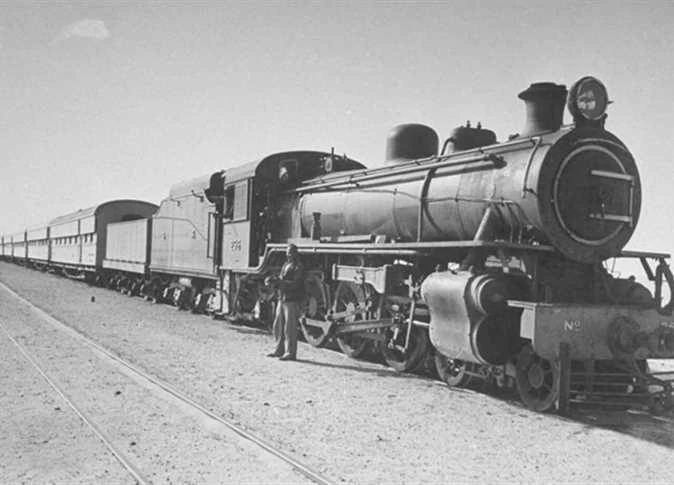
The idea of building a railway between Cairo and Alexandria emerged during the reign of Muhammad Ali Pasha. A Scottish engineer, Thomas Galloway, who worked for Muhammad Ali, proposed the project but was met with rejection due to the high costs and uncertainty of its profitability. After Galloway's proposal was dismissed, Robert Stephenson took over and promoted the idea of a railway line between Cairo and Alexandria, with plans for another line between Cairo and Suez.
Following the death of Ibrahim Pasha, Robert Stephenson attempted to influence Abbas Pasha, who was Muhammad Ali's grandson and deputy. After Muhammad Ali's death and Abbas Pasha's ascension to the throne, Britain saw an opportunity to push for the project's implementation. The British managed to secure Abbas Pasha's approval for the construction of a railway line between Cairo and Alexandria. A decree was issued, which included the establishment of three offices in Alexandria, Cairo, and a third office along the route to oversee the project's requirements.
On 23 September 1852, the construction of the Cairo-Alexandria railway officially began. The British appointed Bruce as their agent and consul general in Egypt in 1853, who believed that the railway line would be of little value without the construction of the Cairo-Suez line. Bruce and Stephenson successfully convinced Abbas Pasha to approve the project. However, before the completion of the Cairo-Alexandria line and the start of work on the Cairo-Suez line, Abbas Pasha was assassinated on 14 July 1854.
After Abbas Pasha's assassination, Said Pasha took over and honored his predecessor's commitments. At the time of Abbas Pasha's death, only about 70 miles of the railway line had been completed. Said Pasha issued orders to complete the first line and begin work on the second line, as well as finish the construction of the Qabaraya station. The project progressed, and by 1855, the railway lines were completed.
The construction of the railway line included the establishment of bridges, such as the one over the Damietta branch at Benha in 1856 and the one at Kafr El Zayat in 1859. The completion of the railway line significantly reduced travel time between Alexandria and Cairo, dropping from 42 hours to just seven hours.
The Cairo-Alexandria railway was a significant development in Egypt's transportation infrastructure, marking the beginning of a new era in land travel between the two major cities. The project was a result of collaboration between Egyptian and British authorities, with British engineers and consultants playing a crucial role in its implementation.
The construction of the railway line had a profound impact on Egypt's economy and society, facilitating the movement of people and goods between Cairo and Alexandria. The project demonstrated the potential for modernization and development in Egypt, setting the stage for future infrastructure projects.
Key points
- The construction of the Cairo-Alexandria railway began on 23 September 1852.
- The project was completed in 1855, reducing travel time between Alexandria and Cairo from 42 hours to seven hours.
- The railway line was a significant development in Egypt's transportation infrastructure, marking the beginning of a new era in land travel between the two major cities.