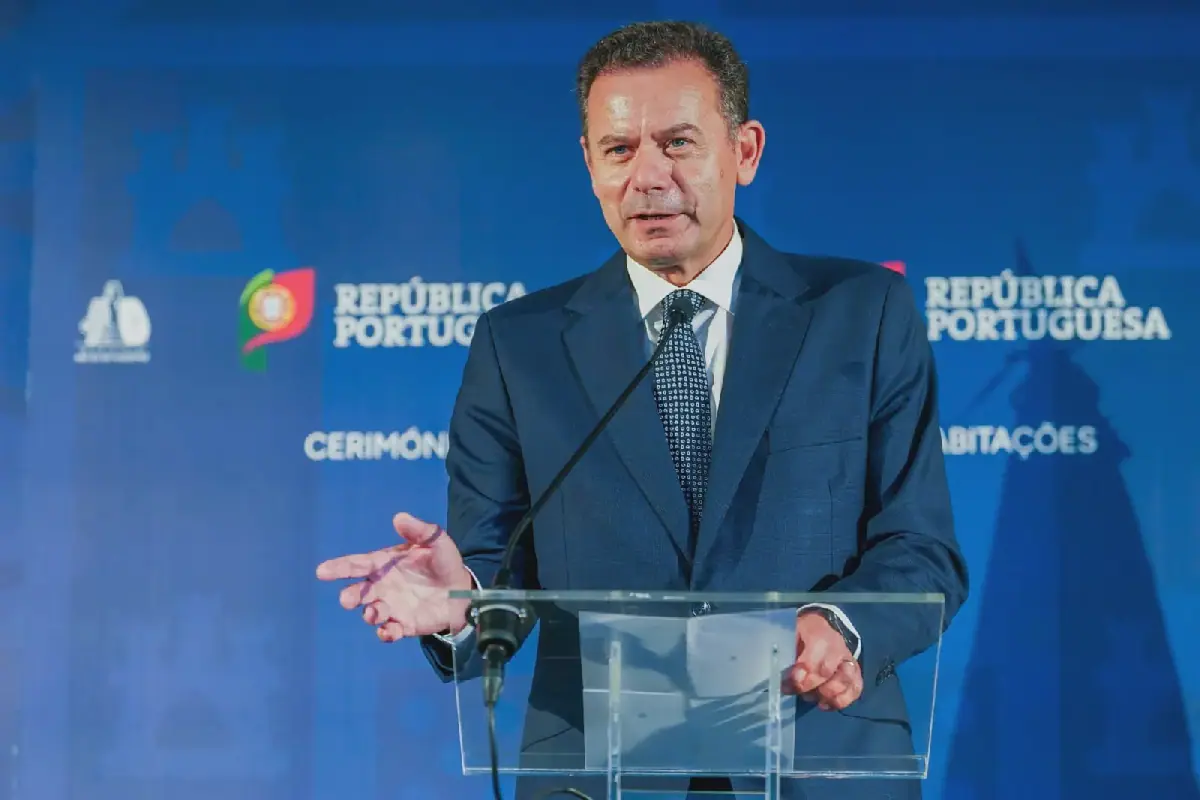
Portuguese Prime Minister Luís Montenegro recently announced that his government would not implement certain measures approved by opposition parties as part of the 2027 State Budget. These measures include the introduction of a zero Value-Added Tax (VAT) on essential food items and an increase in the Income Tax (IRS) rate on house rentals from 10% to 25%. Montenegro stated that the government views these measures as interference in the executive sphere and mere recommendations.
Constitutionalists Tiago Duarte and Vital Moreira have expressed differing opinions on the legitimacy of the government's decision. Duarte, a professor of Constitutional Law at the Catholic University, argues that the government's refusal to apply the zero VAT rate is not a rejection of the law, as the parliament-approved norm does not specify which products would be exempt. He cited a 1987 Constitutional Court ruling that determined the parliament cannot oblige the government to legislate.
Duarte further stated that if opposition lawmakers wanted to apply a 0% VAT to specific products, they should have included this in the budget law. He emphasized that the government cannot be forced to legislate against its will. In contrast, Moreira, a former PS deputy, wrote that the government's refusal to execute a recently voted parliamentary norm "has no precedent" and considered Montenegro's announcement a "qualified provocation" against the respect due to the Assembly of the Republic.
Moreira argued that Montenegro's decision amounts to a "political disobedience" for which he lacks legitimacy. Although he acknowledges that the exemption of VAT on food raises constitutional doubts, he believes the government has no right to resist complying with legal norms due to alleged unconstitutionality. Both constitutionalists agree that doubts exist regarding the constitutionality of revoking the tax benefit on rents up to €2,300.
Duarte and Moreira diverge on the implications of the government's decision. Duarte believes that the increase in the IRS rate from 10% to 25% would be unconstitutional due to the "violation of trust and legitimate expectations of citizens." He suggests that the President of the Republic could refer this matter to the Constitutional Court. Moreira also admits that ending the tax benefit may harm trust in the legislator and the state among landlords who decided to rent due to this benefit.
The two constitutionalists differ on the role of the President of the Republic in this matter. Moreira thinks that António José Seguro should submit both norms to the Constitutional Court's preventive review, considering they may be deemed unconstitutional. Duarte views the disagreement as part of the "normalcy of the relationship between the government and parliament when there is no absolute majority."
Meanwhile, Chega party leader André Ventura announced his intention to include the list of food items covered by the zero VAT in the final text of the Budget. Duarte considers this move not feasible, as it would not be a mere formal correction. He added that potential opposition from Chega to the final text does not jeopardize the Budget's approval. RecordTV Cabo Verde and Lusa reported on the statements from the constitutionalists and the government's decision.
Key points
- Constitutionalists Tiago Duarte and Vital Moreira express differing views on the government's decision not to implement certain budget measures.
- The disagreement centers on the legitimacy of the government's refusal to execute parliamentary-approved norms.
- The issue raises questions about the constitutionality of certain budget measures and the role of the President of the Republic.