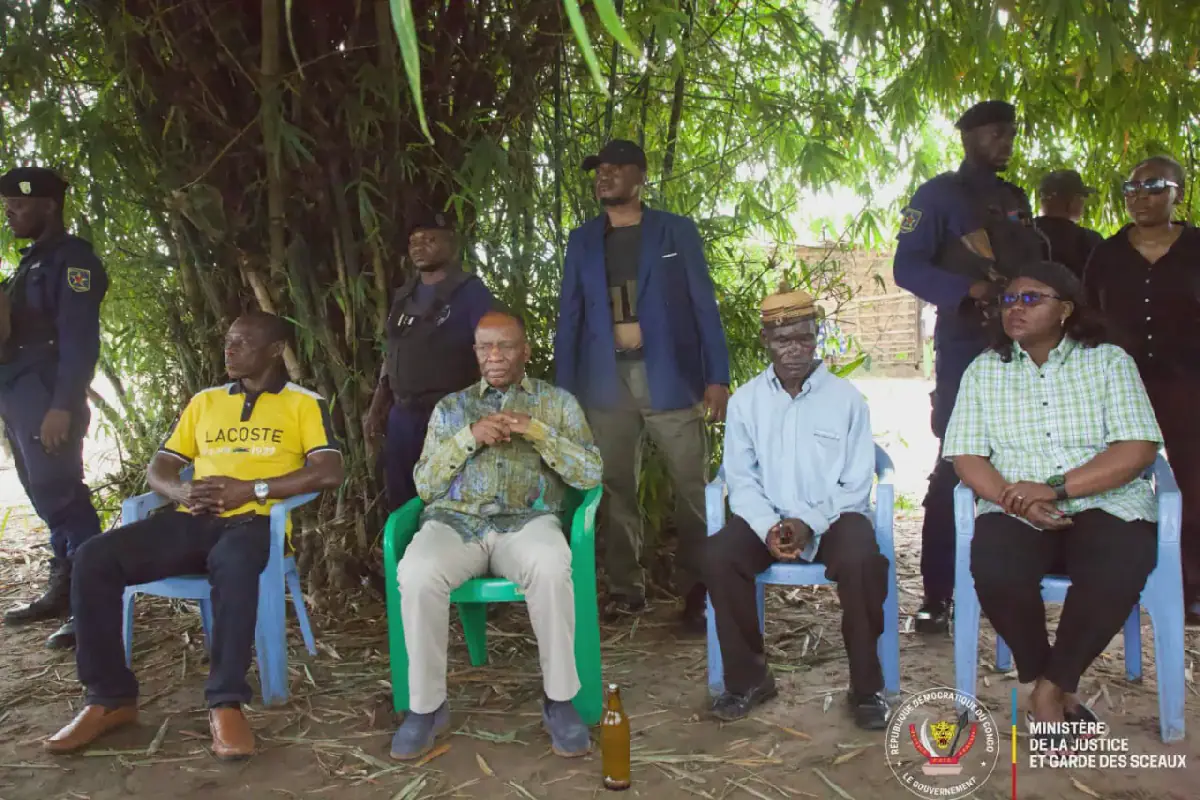
Residents of Ibansi, a village in the Bulungu territory of Kwilu province in the Democratic Republic of Congo, recently met with Minister of Justice Ngefa to express their concerns about the local justice system. They claim they face significant challenges in accessing justice, citing arbitrary arrests, extortion, and a lack of fairness in the application of the law. The meeting was an impromptu gathering, with the minister stopping in the village on his way to Idiofa to hear the concerns of the local population.
During the meeting, residents shared their experiences of conflicts over land, disputed arrests, and alleged extortion by security agents. Layobo Muke, a 70-year-old farmer, stated that those with financial means have better access to justice, while those who cannot afford it are often left without recourse. The minister assured the residents that he was there to listen and not for a political rally, emphasizing the need for justice that is close to the people.
The residents also accused local security forces, including the DRC Armed Forces (FARDC), the Congolese National Police (PNC), and a local intelligence service known as "Bureau 2," of abuses. Élie Bitula, president of the village youth, claimed that these forces carry out arbitrary arrests and demand money, sometimes up to 500,000 Congolese francs, for the release of detainees. He also alleged that some agents use torture, though these allegations could not be independently verified.
Célestine Kahanga, a 65-year-old farmer and mother of several grandchildren, shared her own experience of struggling to secure the release of a grandson who was imprisoned in Kikwit due to an inability to pay the demanded sums. She stated that some families are forced to gather between 500,000 and 1 million francs to secure the release of their loved ones. These testimonies highlight the challenges faced by rural populations in accessing judicial institutions and obtaining protection for their rights.
The minister's visit to Ibansi is part of a broader inspection mission in the Kwango and Kwilu provinces aimed at addressing the "judicial desert" – a phenomenon where judicial institutions are concentrated in large cities, leaving rural areas underserved. The goal is to ensure that populations have access to fair, impartial justice that respects their rights, including in their interactions with law enforcement agencies.
The issues raised in Ibansi reflect a broader challenge in the DRC, where the concentration of judicial resources in urban areas often leaves rural communities without adequate access to justice. The minister's engagement with local residents underscores the need for reforms that can bring justice closer to the people and address the systemic issues that lead to abuses and extortion.
The situation in Ibansi and similar rural areas highlights the importance of judicial reform and the need for increased resources to ensure that all citizens have equal access to justice, regardless of their location or financial means. The minister's visit and the testimonies collected during the meeting are expected to inform efforts to improve the justice system in the DRC and address the concerns of rural populations.
Key points
- The residents of Ibansi are demanding a more accessible and fair justice system.
- The DRC's "judicial desert" leaves many rural areas without adequate access to justice.
- The minister's visit aims to address systemic issues leading to abuses and extortion in rural areas.
Reporting sources
- Kwilu : difficultés d’accès à la justice et abus exposés au ministre à Ibansi · Congolese press agency