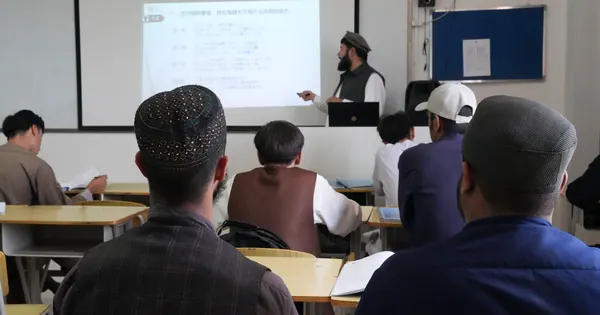
Inside a modern classroom at Kabul University, Jawid Ahmadi is learning Chinese with the goal of pursuing a master's degree and eventually a doctorate in China. His family sees his linguistic progress as a potential catalyst for upward mobility. Ahmadi believes that learning Chinese can contribute to his personal economic growth and the economic development of his country. He also wants to be a bridge of communication and understanding between Afghanistan and China.
The Confucius Institute at Kabul University admits only a limited number of high-school graduates each year through a public entrance exam, despite high demand for Chinese-language instruction. Abbas, a recent graduate, attributes tangible career advantages to his language skills, particularly in the economic sphere. He notes that interest in learning Chinese is growing with each passing day.
For a growing number of young Afghans, proficiency in Chinese has unlocked pathways to higher education, employment, and commercial enterprise. Heela Wardak, an alumna, secured positions in Afghanistan before relocating to Beijing, where she teaches Pashto language at Beijing Foreign Studies University. She regards the institute as an essential conduit for mutual comprehension between Afghans and the Chinese people.
Founded in 2008, the Confucius Institute in Kabul has equipped hundreds of Afghan students with Chinese language skills over nearly two decades. Currently, more than 100 students are enrolled across all academic levels. The institute's executive director, Wahidullah Halimy, notes that demand is driven by the availability of scholarships in China, expanding employment prospects, and the growing presence of Chinese enterprises in Afghanistan's mining sector.
Graduates of the Confucius Institute find employment in Chinese companies, and Halimy reports that all graduates secure employment and are satisfied with their professional careers. To accommodate growing demand, Halimy has urged Afghan authorities and the Confucius Institute to facilitate the placement of additional Chinese instructors. Complementary courses are also offered at Nangarhar University and a private institution in Kabul.
For young Afghans, Chinese has evolved beyond an academic subject into a pragmatic instrument of economic mobility, cross-cultural exchanges, and enhanced bilateral engagement. The institute serves as a bridge connecting Afghans with the Chinese people, providing opportunities to learn about Chinese culture, economy, and society.
As interest in learning Chinese continues to grow, the Confucius Institute is poised to play an increasingly important role in Afghanistan's pursuit of broader international partnerships. With its limited capacity, the institute is working to meet the demands of aspiring learners and provide them with the skills necessary to succeed in an increasingly interconnected world.
Key points
- The Confucius Institute at Kabul University has equipped hundreds of Afghan students with Chinese language skills since its founding in 2008.
- Demand for Chinese-language instruction is driven by the availability of scholarships in China, expanding employment prospects, and the growing presence of Chinese enterprises in Afghanistan's mining sector.
- Graduates of the Confucius Institute find employment in Chinese companies, with all graduates securing employment and reporting satisfaction with their professional careers.