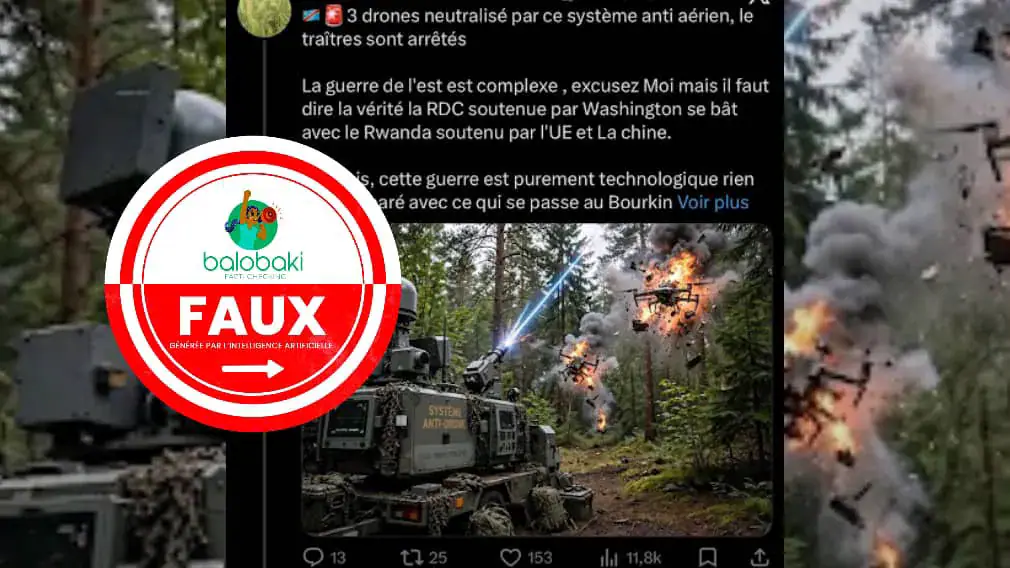
The conflict in eastern Democratic Republic of Congo (DRC) has taken a new turn with the emergence of manipulated images and deepfakes. A photo published on September 11 on social media platform X claims to show a Congolese anti-aircraft system destroying three Rwandan drones. The image had been viewed over 11,000 times and shared by 25 people by September 22. The post accompanying the image stated that three drones had been neutralized by the Congolese system.
An investigation by Balobaki Check, a fact-checking initiative, found no evidence to support the authenticity of the image. A search of the official X account of the DRC's Armed Forces (FARDC) did not yield any information confirming the destruction of the drones. A reverse image search also produced no results. Further verification using Hive Moderation, an AI-generated content detection tool, revealed a 99% probability that the image was AI-generated.
The conflict in eastern DRC has been marked by tensions between the Congolese government and the Rwandan-backed M23 rebel group. The European Union has publicly condemned Rwanda's involvement in the conflict, with EU officials summoning the Rwandan ambassador in February 2025 to demand the withdrawal of Rwandan troops from Congolese territory. The EU has also threatened to withhold 20 million euros in funding for Rwanda's military mission in Mozambique.
The DRC government has received support from the United States, while Rwanda has been accused of receiving backing from China and the EU. However, these claims could not be verified. The spread of misinformation and manipulated images has added to the complexity of the conflict, with both sides using social media to promote their narratives.
The use of AI-generated images and deepfakes has raised concerns about the integrity of information in the public sphere. Fact-checking initiatives like Balobaki Check are working to verify information and counter the spread of misinformation. The incident highlights the need for media literacy and critical thinking in the digital age.
The article was written by Christelle Luyindula Zola, a journalist with the Congolese National Radio and Television, and participant in the Balobaki Check training program. The article was edited by Moïse Esapa.
The verification of the image and the investigation into the conflict in eastern DRC demonstrate the importance of fact-checking and media integrity in conflict zones. The use of AI-generated images and deepfakes can have serious consequences, including the manipulation of public opinion and the escalation of violence.
Key points
- The photo claiming to show a Congolese anti-aircraft system destroying Rwandan drones is AI-generated and not authentic.
- The European Union has condemned Rwanda's involvement in the conflict in eastern DRC and threatened to withhold funding for Rwanda's military mission in Mozambique.
- The conflict in eastern DRC has been marked by the spread of misinformation and manipulated images, highlighting the need for media literacy and critical thinking.