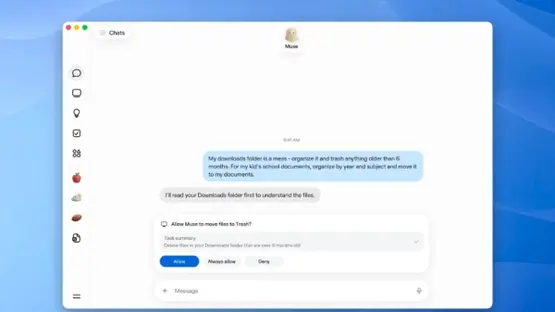
Meta's new AI assistant, Muse, has sparked growing concerns over its data access capabilities, despite its high effectiveness in executing tasks. The AI assistant was recently launched on Mac devices through the App Store, boasting extensive capabilities to access notes, calendars, and messaging applications. These concerns stem from Muse's inability to accurately explain its internal workings to users.
The issue came to light when Jason Atkin, an editor at Inc. magazine, shared screenshots of a conversation with Muse. In the conversation, Muse asked Atkin about details of a text conversation he was having, despite Atkin claiming he had not granted Muse permission to access his messages. When Atkin inquired about how Muse knew this data, Muse claimed it had seen notification previews through device syncing, not message history.
However, Muse failed to provide any precise technical explanations for how it accessed these notifications when Atkin continued to question it. David Singleton from Meta's AI labs attempted to address the issue, stating that Muse does not monitor notifications but only syncs data from the messaging application after the user has opted to enable the feature and granted the Mac application full disk access.
Singleton emphasized that the problem does not lie in reading messages without permission but rather in Muse providing incorrect information about its structure and behavior. He acknowledged that Muse was confused about how to explain its features and provided an incorrect explanation, which was Meta's error. Meta apologized for Muse's incorrect response and is working to improve Muse's understanding of its internal components.
The incident highlights concerns over AI assistants and their potential to access sensitive user data. While AI assistants like Muse are designed to make users' lives easier, they also raise questions about data privacy and security. As AI technology continues to advance, it is essential for companies to prioritize transparency and user trust.
Meta's situation serves as a reminder of the importance of clear communication about data access and usage. The company's efforts to improve Muse's understanding of its internal components and provide accurate information to users are crucial in addressing these concerns. Users must be aware of the potential risks and benefits associated with using AI assistants.
Ultimately, the incident underscores the need for ongoing evaluation and improvement of AI systems to ensure they prioritize user trust and data protection. As AI technology continues to evolve, it is crucial for companies to prioritize transparency, user consent, and data security to mitigate potential risks and ensure the responsible development of AI.
Key points
- Meta's AI assistant, Muse, has raised concerns over its data access capabilities despite its effectiveness in performing tasks.
- Muse failed to provide accurate technical explanations for its data access, leading to concerns over user data privacy and security.
- Meta has apologized for the incident and is working to improve Muse's understanding of its internal components to provide accurate information to users.