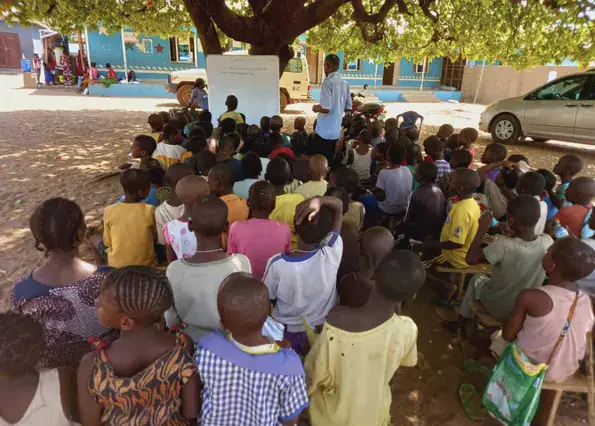
A community-led education initiative in Benue State, Nigeria, is providing a lifeline for displaced children, helping them build foundational literacy and numeracy skills. The Fortress of the Vulnerable Child Rescue Initiative, launched in 2021, has enrolled 425 pupils across seven classes, despite facing challenges in retaining students due to ongoing displacement. The initiative's founder, Amos Terhumba Agber, said the organisation aims to make education accessible to children in displacement settings.
Ten-year-old Amos Terkura's journey to learning began after he lost his father and fled his community with his mother, Erdoo Terkura, following an attack in November 2021. When his mother enrolled him in the community-led school in December 2021, Amos struggled to identify even the English alphabet. However, with the school's focused curriculum and teaching approach, he has progressed from recognising letters to forming words and completing dictation exercises.
The school's teaching approach prioritises basic reading and arithmetic, accommodating pupils with different levels of prior learning. The initiative's founder, Amos Terhumba Agber, said the organisation grouped children according to their literacy levels, allowing teachers to focus on specific skills each group needed to develop. This approach has enabled pupils like Amos to make significant progress in their education.
The initiative was born out of a need to address the education gap for displaced children. Agber, a sociologist living near the camp, said he visited an IDP camp in November 2021 and found children roaming around during school hours. He estimated that registering over 500 children in nearby public schools would cost around ₦7.5 million, an amount he could not raise quickly. Instead, he decided to establish a learning space inside the camp and recruit volunteer teachers.
Despite the progress made, the school faces challenges in sustaining learning and retaining pupils. The decline in enrolment from 750 to 425 pupils reflects, in part, families being displaced as they move between camps and communities. Agber said the organisation is working to ensure that any child who stays with them for a full session greatly improves their reading skills, which can help them build on later.
For Amos's mother, the school's value is tied to the education she had struggled to provide before displacement. She said she could not afford to send him to school, while recurring violence in and around their community disrupted public education and discouraged teachers from remaining at their posts. The school has become a beacon of hope for families like Amos's, providing a chance for children to rebuild their education.
The community-led school's experience raises important questions about educating displaced children and how pupils can recover lost learning when their lives remain unsettled. As the initiative continues to operate, it highlights the importance of community-led education initiatives in bridging the education gap for displaced children. The school's focus on basic literacy and numeracy skills has shown promising results, offering a model for similar initiatives in other displacement settings.
Key points
- The community-led school in Benue State has enrolled 425 pupils across seven classes, focusing on basic literacy and numeracy skills.
- The school's teaching approach prioritises basic reading and arithmetic, accommodating pupils with different levels of prior learning.
- The initiative faces challenges in sustaining learning and retaining pupils due to ongoing displacement.