The Commission for University Education (CUE) in Kenya has expressed concerns over a widening skills gap in the country as universities admit more students into courses with high enrolment while fewer learners take up science, technology, engineering, mathematics and agriculture programmes needed in several parts of the economy. According to CUE's University Statistics Report 2025, education and arts remained the biggest areas of university enrolment in 2025, with a combined 132,039 students. Business followed with 103,742 students, while education science had 61,369.
The report shows that social sciences enrolled 31,818 students and arts 28,856. In comparison, engineering had 31,245 students, agriculture 23,245, information and computer technology 22,401, computer science 19,706, and mathematics and statistics 18,517. These figures have raised concern because employers are increasingly seeking workers with specialised professional and technical abilities. The Kenya Labour Market Information System indicates that professionals make up about half of advertised vacancies, showing that employers are placing strong demand on particular skills and areas of expertise.
The demand for specialised skills is spread across several sectors, including finance, sales, policy and planning, software development and technical services. A separate Federation of Kenya Employers survey also points to information technology as the career area where employers most frequently reported a need for skills. Finance and business management came next, followed by engineering and transport, distribution and logistics. Among engineering disciplines, computer and software engineering made up the largest portion of the skills sought by employers surveyed.
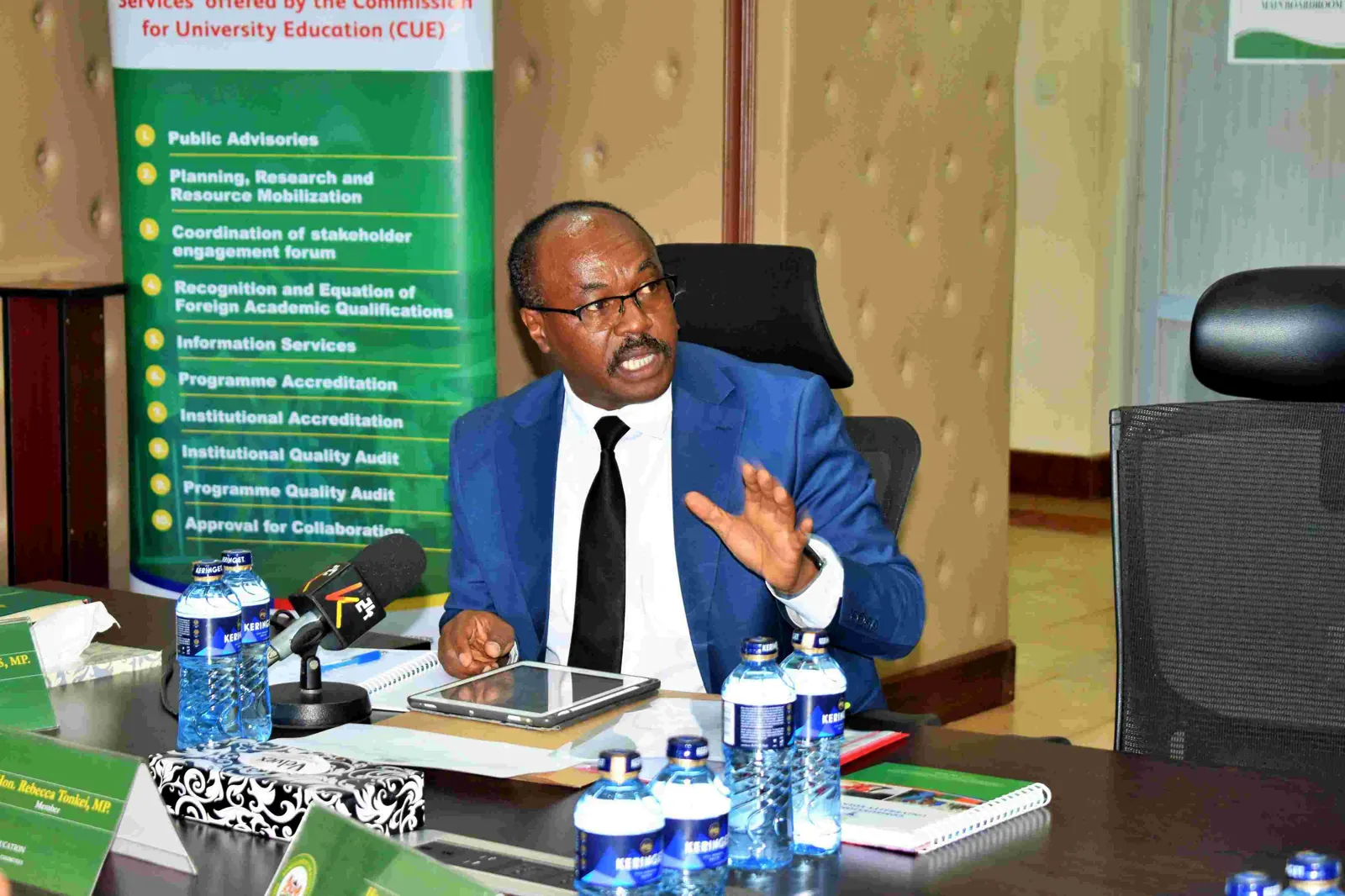
CUE Chief Executive Officer Prof. Mike Kuria has highlighted the risks of creating a mismatch between graduate output and labour market needs, potentially leading to graduate unemployment in oversubscribed fields and skills shortages in critical sectors. The report notes that education and arts produced the largest number of graduates in 2025, with 37,817 and 30.3 per cent of all graduates. Business, administration and management studies followed with 24,194 graduates, representing 19.4 per cent.
However, natural sciences, mathematics and statistics recorded the largest proportional fall in graduate numbers, losing 1,922 graduates in 2025, with their share of total graduates dropping from 8.9 per cent to 7.3 per cent. Engineering recorded a decline of 622 graduates, while agriculture lost 196. CUE noted that the graduate pipeline is drifting away from Stem toward service-oriented disciplines, representing a compounding erosion of technical capacity.
To address this issue, CUE is pushing for stronger career guidance in secondary schools and universities to help students understand opportunities in different fields before choosing their courses. The commission is also calling for more internships and closer partnerships between universities and industry so that training can better reflect the needs of employers. CUE has proposed targeted support, including scholarships and subsidies, to encourage more students to pursue courses that currently attract fewer learners but are considered important to the country.
The warning comes as the number of university students continues to grow, with enrolment increasing from 628,431 in 2024 to 707,150 in 2025. CUE said the rapid growth of the university sector makes it more important to ensure that the courses being offered and the skills graduates acquire are linked to available employment opportunities. The commission's efforts aim to align university education with the needs of the labour market and support national development.
Key points
- The Commission for University Education warns of a growing mismatch between university training and labour-market requirements in Kenya.
- Education and arts remain the biggest areas of university enrolment, while Stem programmes face declining numbers.
- CUE proposes stronger career guidance, internships, and targeted support to address the skills gap.