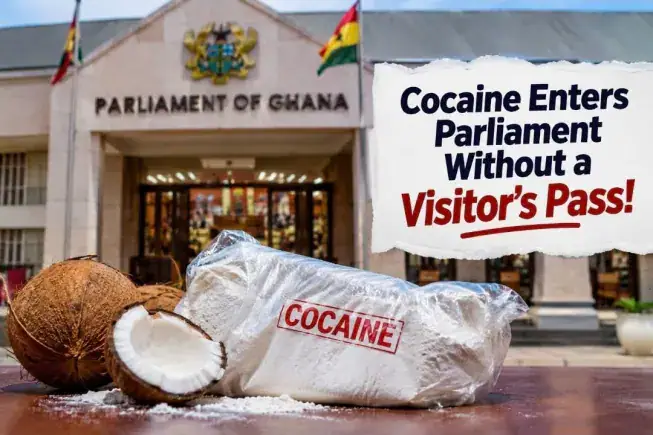
A recent seizure of approximately 2.6 tonnes of cocaine concealed in containers carrying coconuts shipped from Ghana has sparked debate in Ghana's parliament. The incident has raised concerns about the country's security arrangements and the effectiveness of its measures to prevent narcotics trafficking. The Minority in parliament has questioned the government's handling of the issue, demanding explanations for the seizures.
The incident is not an isolated one, as earlier, French authorities had intercepted nearly 3.9 tonnes of cocaine in a container carrying plastic waste linked to Ghana. These seizures have generated considerable interest among European customs officials and have embarrassed the Ghanaian government. The country's leaders have long promoted Ghana as an attractive investment destination, encouraging farmers to grow more cocoa, entrepreneurs to export processed foods, and manufacturers to conquer international markets.
However, some criminal entrepreneurs appear to have misunderstood the assignment, using Ghana's shipping routes for their unlawful ambitions. The latest incidents have involved coconuts and plastic waste, which have been used to conceal multimillion-dollar consignments of cocaine. Environmentalists have urged Ghanaians to recycle plastics rather than pollute their rivers and drains, but some criminal minds have developed their own interpretation of waste management.
In parliament, the debate has centred on accountability and the government's response to the seizures. The Minority has legitimate questions about the effectiveness of Ghana's security arrangements, and it is reasonable to demand explanations. However, Ghanaian politics has a remarkable ability to transform serious national problems into contests over who deserves the greater portion of disgrace.
The government has been promoting its vision of a 24-hour economy, promising jobs, productivity, and economic transformation. The Minority, meanwhile, has found an opportunity to introduce cocaine into the national economic conversation. One can only imagine the confusion this might cause among citizens who take political slogans literally.
The incident has also raised questions about the need for a compulsory course in Advanced Parliamentary Accountability. The correct response to a large consignment of cocaine linked to Ghana being intercepted abroad is to investigate how the shipment escaped detection and identify those responsible. However, in the Republic of Uncommon Sense, considerable parliamentary energy may be expended debating other issues before anybody remembers the correct course of action.
The real comedy began when cocaine found its way into parliamentary politics, with the Minority using the issue to question the government's competence. Unfortunately, Ghanaian politics has a tendency to change the interpretation of a problem without changing the problem itself. Our politicians have perfected the art of changing their interpretation of a problem without changing the problem itself, and therein lies the serious matter beneath the laughter.
Key points
- The Ghanaian government must investigate how the shipment of cocaine escaped detection and identify those responsible.
- The incident has raised concerns about the country's security arrangements and the effectiveness of its measures to prevent narcotics trafficking.
- The debate in parliament has centred on accountability and the government's response to the seizures.