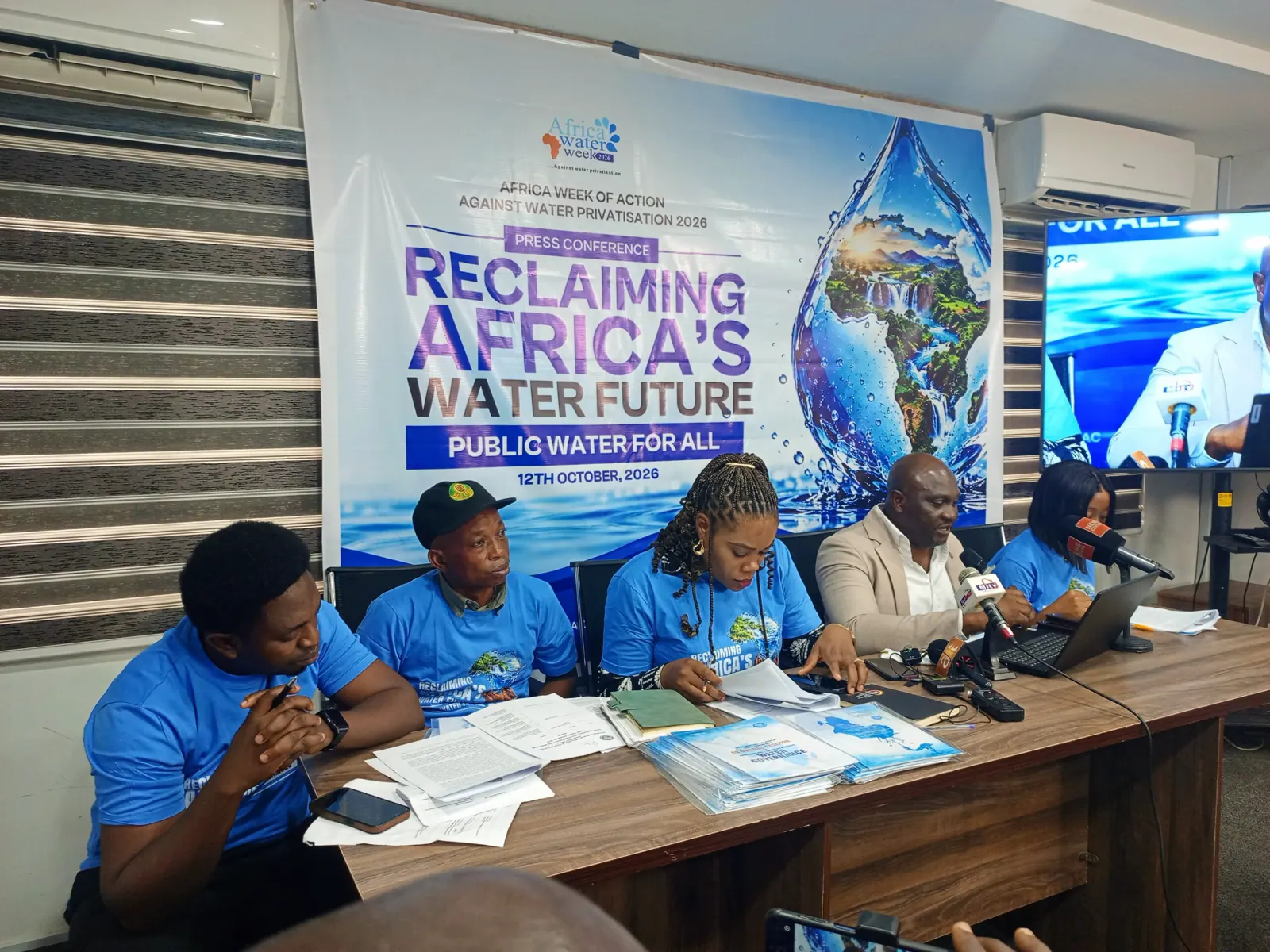
A coalition of development-focused groups and individuals has warned that privatising water services in Lagos could exacerbate inequality. The warning was given during the Africa Week of Action Against Water Privatisation 2026, organised by the Our Water, Our Right Africa Coalition (OWORAC) in Lagos. The coalition urged the Lagos State Government to invest more in public water infrastructure, rather than pursuing privatisation.
Rufus Olusesan, president of the Precision, Electrical and Related Equipment Senior Staff Association (PERESSA), stated that private operators could prioritise profitable areas, neglecting underserved communities such as Ajegunle and Makoko. He emphasised that water is a human right, not a commodity. Mr Olusesan called on the Lagos State Government to allocate at least five per cent of its annual budget to water infrastructure, citing the current allocation as less than one per cent.
The coalition's joint statement, read by Geoffrey Occansey of Ghana's Water Citizens Network/Revenue Mobilisation Africa, noted that inadequate public investment, population growth, urbanisation, and climate pressures have worsened water supply challenges across Africa. The statement cited global figures showing that 2.1 billion people lacked safely managed drinking water in 2024, while 3.4 billion lacked safely managed sanitation. In sub-Saharan Africa, 167 million people relied on limited drinking-water services that year.
The coalition argued that households without reliable public water supplies often depend on vendors, tankers, and private boreholes, leaving poorer residents to pay more for an essential service. Research on urban water access in sub-Saharan Africa showed that low-income households relying on vendors could pay between 10 and 20 times more per unit of water than households connected to public networks. This has been termed a "poverty penalty."
The coalition warned that commercial tariffs, concessions, public-private partnerships, and prepaid water meters could worsen inequality if access increasingly depends on households' ability to pay. They cited concerns about private sector involvement in water services, including a 2025 Global Witness investigation into a Veolia-managed landfill in Colombia. The coalition called on African governments to publish water-related contracts, financing arrangements, tariffs, and expenditure.
Opposition to private-sector participation in Lagos water services predates the latest campaign. The Amalgamated Union of Public Corporations, Civil Service, Technical and Recreational Service Employees (AUPCTRE) previously opposed the Lagos State Government's plan to operate its waterworks through a public-private partnership (PPP) arrangement. The union accused the management of the Lagos Water Corporation of using water scarcity to persuade residents that private-sector participation was necessary.
At the event, Mr Olusesan proposed a water board comprising government representatives, workers, community groups, and civil society organisations. He suggested that the board should publish its budgets and expenditure quarterly to enable residents to monitor public spending. Additionally, he alleged that the Lagos Water Corporation disengaged more than 800 workers in 2024 to make the corporation more attractive to investors, warning that this could undermine job security and pension entitlements.
Key points
- Privatisation of water services in Lagos could make water less affordable for poor residents.
- The coalition urges the Lagos State Government to invest more in public water infrastructure.
- Inadequate public investment and population growth have worsened water supply challenges across Africa.