President Bola Tinubu has announced that Nigerians can expect significant reductions in transportation costs starting from October 1. This will be achieved through the expanded use of Compressed Natural Gas (CNG)-powered transit, which is a cheaper alternative to traditional fossil fuels. According to Tinubu, the Federal Government is working closely with state governments and transport stakeholders to ensure that the savings from cheaper energy translate into lower fares for commuters.
Tinubu made this announcement in a statement personally signed by him on Saturday. He recalled a meeting with the governors of the 36 states on August 27, where they agreed to work together to make CNG-powered transit a reality. An implementation committee for the National Affordable CNG Transit Programme was subsequently established under the Nigeria Governors' Forum, with Governor AbdulRahman AbdulRazaq of Kwara as its chairman. The committee is working with stakeholders to identify priority transport corridors and determine appropriate interventions.
The implementation committee, which includes the Presidential Initiative on CNG (PI-CNG) and Electric Vehicles, states, and other stakeholders, is working to put necessary arrangements in place. Tinubu cited existing CNG and electric transport initiatives across states as evidence that cheaper energy can translate into significant savings for commuters. For example, in Borno, CNG-powered and electric public transport services charge commuters between N50 and N100 on routes where commercial operators charge N300 to N600.
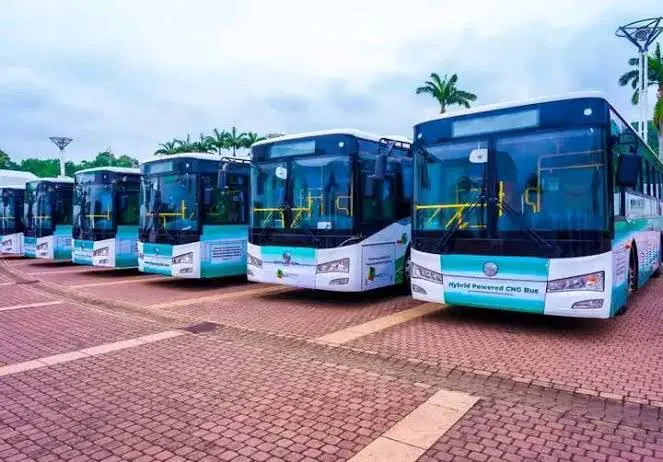
Tinubu provided more examples of the success of CNG-powered transit in various states. In Kaduna, 100 CNG-powered buses provide free transportation on major routes, carrying about 3.2 million passengers in their first year and saving commuters more than N3.5 billion in transportation costs. In Oyo, CNG buses deployed to Pacesetter Transport reduced the Lagos-Ibadan fare from about N8,000 to N3,200 during initial deployment. In Adamawa, alternative-energy transit services have cut fares by as much as 50 percent, from N8,000 to N4,000.
The President also highlighted the success of CNG-powered transit in other states. In Enugu, where 100 CNG buses have been deployed, the Enugu-Nsukka fare has fallen from N2,500 to N1,500. In Plateau, government-supported buses carry about 13,000 commuters daily at N200, compared with more than N500 charged commercially. Through a partnership with the National Union of Road Transport Workers (NURTW), passengers on CNG-converted commercial vehicles on several Abuja routes receive a 40 percent fare reduction.
Tinubu emphasized the need for the Federal Government and state governments to work together to sustain the momentum towards October 1. He urged governors to work with transport unions and commercial operators to support conversion and fleet deployment. The President assured that the Federal Government would continue to support CNG infrastructure, conversion capacity, and access while creating an enabling environment for investors.
Tinubu concluded by stating that Nigeria has the potential to reduce its exposure to global energy market pressures through cheaper alternatives. He noted that his administration had, over the last three years, invested deliberately in building a CNG transportation ecosystem across Nigeria. More than 120,000 vehicles have been converted, with over 400 certified conversion centers and more than 90 CNG refueling stations nationwide.
Key points
- President Bola Tinubu assures Nigerians of reduced transportation costs from October through expanded use of cheaper CNG-powered transit.
- The Federal Government is working with state governments and transport stakeholders to ensure savings from cheaper energy translate into lower fares.
- Existing CNG and electric transport initiatives across states have already led to significant savings for commuters.