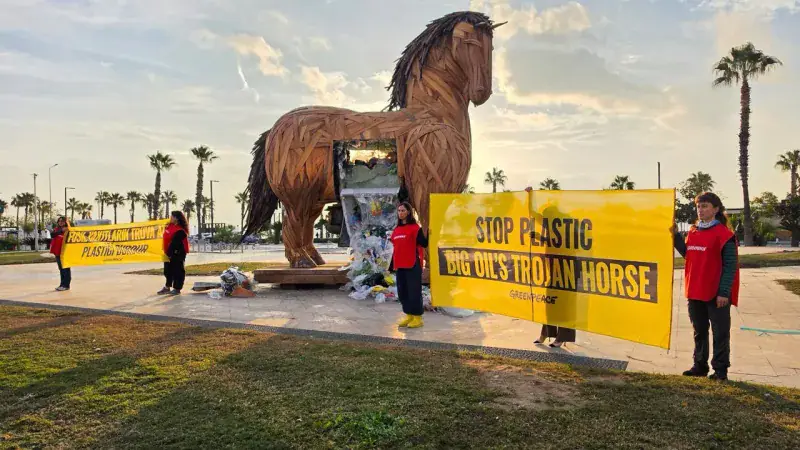
Greenpeace International has unveiled a giant Trojan Horse installation at the UN Climate Change Conference in Antalya, Türkiye, to highlight the fossil fuel industry's use of plastic production to sustain demand for oil and gas. The installation, created in collaboration with Danish artist Thomas Dambo, stands six metres high and four metres wide at Konyaalti Municipality. It released plastic when a trapdoor in its belly opened, carrying a message to world leaders: plastic is Big Oil's Trojan Horse.
The installation draws on the ancient legend of Troy to illustrate the hidden dangers of the plastics industry. Berk Butan, Social and Economic Systems Campaigner at Greenpeace Türkiye, said the legend of Troy was a striking story deeply rooted in the ancient history of the region. The fossil fuel industry is using plastic as an escape hatch, and Türkiye is promoting its Zero Waste initiative to the world at COP31. However, a comprehensive Zero Waste policy requires placing limits on plastic production and closing borders to other countries' plastic waste.
Greenpeace says the expansion of plastic production is being driven by an industry seeking to protect its profits, sustain demand for oil and gas, and undermine climate action. Plastic contributes to the climate crisis throughout its life cycle, from fossil fuel extraction and manufacturing to disposal. The organisation claims that African countries are at risk of bearing the consequences of the industry's actions, with Fred Njehu, Pan-African Political Strategist at Greenpeace Africa, stating that the fossil fuel industry is using plastic production as a Trojan Horse to lock Africa into decades of continued extraction and pollution.
Thomas Dambo, the Danish artist behind the installation, said he used recycled materials and waste to create his sculptures as a way of challenging overproduction. He hopes that the Trojan Horse will spark curiosity and send a clear message: a healthier climate means cutting plastic production. The installation is part of Greenpeace's plastics campaign, which aims to expose the connection between plastic production and the fossil fuel industry.
Greenpeace is calling on governments to adopt a strong Global Plastics Treaty that cuts plastic production at its source, accelerates a just transition away from fossil fuels, and supports reuse and refill systems. The organisation challenged COP31 leaders to confront the fossil fuel interests behind plastic production, stating that a healthy climate and a Zero Waste future depended on reducing plastic production and putting people and the planet before corporate profits.
Jacob Kean-Hammerson, Global Plastics Policy Lead at Greenpeace USA, said governments could not address climate change without tackling the expansion of plastic production. He stated that plastic is Big Oil's Trojan Horse – a way to keep profiting from fossil fuels and continued climate emissions and pollution. Governments must stand up to fossil fuel interests and commit to a just transition away from fossil fuels and cutting plastic production.
The next Global Plastics Treaty negotiations are scheduled for March 2027, and Greenpeace is urging leaders to take a decisive stance and fight for true Zero Waste. The organisation claims that a binding treaty that cuts plastic production at the source and makes corporate polluters pay for the devastating impacts of their entire toxic supply chain on African frontline communities is necessary to address the climate crisis.
Key points
- Greenpeace International unveils a giant Trojan Horse installation at COP31 to expose the fossil fuel industry's use of plastic production to prolong dependence on oil and gas.
- The installation draws on the ancient legend of Troy to illustrate the hidden dangers of the plastics industry.
- Greenpeace is calling on governments to adopt a strong Global Plastics Treaty that cuts plastic production at its source and supports a just transition away from fossil fuels.