Civil society groups in South Sudan are calling on the Unity State government to facilitate the relocation of students from Panyijiar County to allow them to sit their national examinations. This appeal comes after Jonglei State's decision to transport candidates from Akobo County to Bor for their exams. The National Civil Society Coalition (NCSC) is leading the push for Unity State to make similar arrangements.
Bol Deng Bol, Chairperson of the NCSC, has appealed to the Unity State government to initiate communication with authorities in Panyijiar County, including the armed opposition, to facilitate the relocation of affected students. He welcomed Jonglei's decision to take responsibility for transporting Akobo's Primary Eight and Senior Four candidates to Bor, saying students should not be caught up in political and military divisions.
The NCSC commended Jonglei for taking responsibility for relocating the candidates and reaching an understanding with authorities in Akobo, including the armed opposition, to prioritise students' interests. The coalition urged Unity State to make similar arrangements to ensure that affected students in Panyijiar sit their examinations. This move aims to prevent students from being disadvantaged due to their location.
A total of 534 Primary Eight candidates from Akobo East and Akobo West in Jonglei State, as well as Nyal and Ganyliel in Unity State, were excluded from the 2026 national examinations over security and safety concerns. Caretaker Minister of General Education and Instruction Kuyok Abol Kuyok said attempts to relocate the affected candidates to safer examination centres had failed after local authorities reportedly denied examination personnel, monitors and supervisors access to the designated centres.
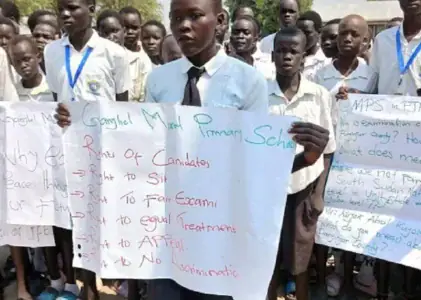
Students in Akobo staged a peaceful demonstration on November 14, demanding the opportunity to sit their examinations. Akobo is under the administration of the Sudan People's Liberation Army in Opposition (SPLA-IO), a political and administrative division that has complicated coordination over the administration of national examinations. The situation highlights the challenges faced by students in conflict-affected areas.
Bol Deng Bol argued that the national government should have anticipated security challenges in opposition-controlled areas and initiated dialogue with armed opposition authorities before the examinations. The NCSC's appeal to Unity State aims to ensure that students are not disadvantaged due to their location. The situation requires a collaborative effort from all stakeholders to find a solution.
The South Sudan National Examinations Council made the decision to exclude the students from the examinations due to security concerns. However, civil society groups are pushing for a more inclusive approach that prioritises students' interests. The outcome of the appeal remains to be seen, but it is clear that the situation requires a collaborative effort from all stakeholders.
Key points
- The National Civil Society Coalition is urging Unity State to relocate students from Panyijiar County to enable them to sit their national examinations.
- Jonglei State has decided to transport candidates from Akobo County to Bor for their exams, prompting calls for similar arrangements in Unity State.
- A total of 534 students were excluded from the 2026 national examinations over security and safety concerns.