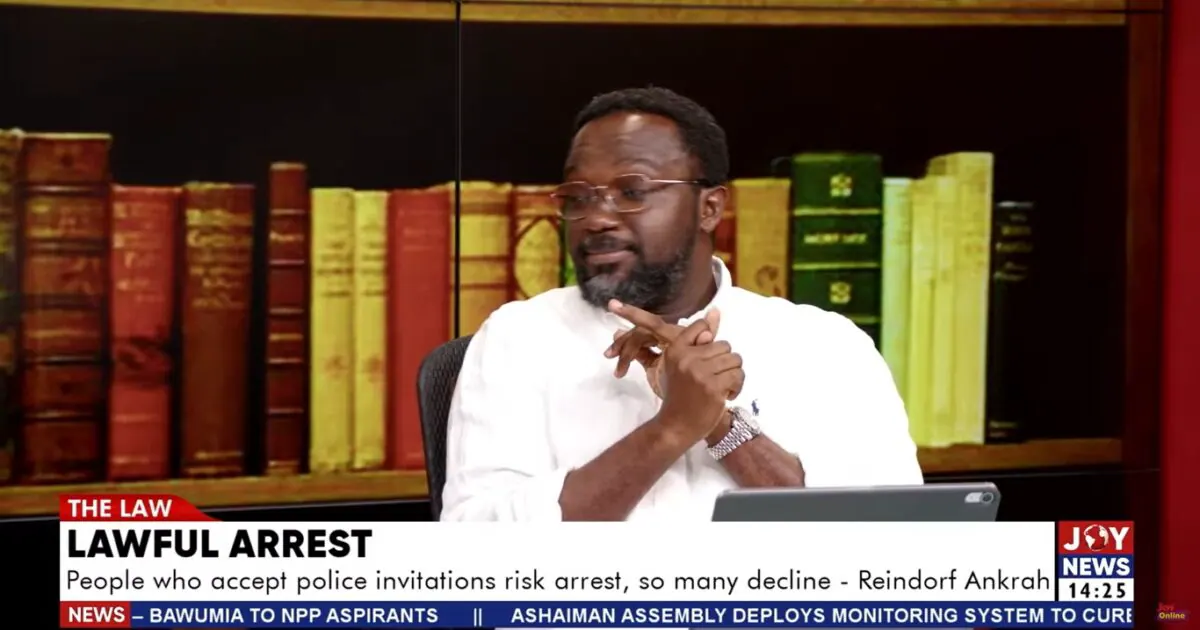
Private legal practitioner Reindorf Twumasi Ankrah has expressed concerns that the practice of arresting individuals after inviting them to assist investigations is creating fear among citizens. As the acting CEO of the Ghana Integrated Aluminium Development Corporation (GIADEC), he noted that this uncertainty has led to reluctance among people willing to provide information to investigators. Speaking on JoyNews, he emphasized that law enforcement agencies must address the apprehension their practices have generated.
According to Twumasi Ankrah, the practice has shown that when people voluntarily submit themselves or attend an invitation extended by the police, they often end up being arrested. This has led some citizens to prefer waiting for a formal arrest rather than honouring an invitation that could result in unexpected detention. He explained that people now take the position of not honouring such invitations and instead ask the police to exercise their powers of arrest.
Twumasi Ankrah acknowledged that invitations are a legitimate means of obtaining information, particularly when investigators have not established whether an individual should be considered a suspect. An invitation may simply require someone to supply documents or clarify facts relevant to a case involving another person. However, he noted that the repeated use of invitations leading to arrests has undermined citizens' confidence in the process.
The practice has created fear among citizens, who are now balancing their willingness to help investigators establish the truth against concerns about their personal liberty. Twumasi Ankrah stated that there is a genuine fear that when citizens attend an invitation, there is a likelihood they won't return home. He advised individuals to seek legal representation when attending an invitation, given the possibility that their role in an investigation could change.
Twumasi Ankrah further argued that once officers prevent an individual from leaving, they must recognize the change from voluntary attendance to detention and safeguard the person's constitutional rights. He emphasized that law enforcement agencies must address the apprehension their practices have generated to restore citizens' confidence in the process.
The issue has significant implications for investigations, as citizens become increasingly hesitant to cooperate with the police. Twumasi Ankrah's comments highlight the need for law enforcement agencies to re-examine their practices and ensure that invitations are not used as a means of luring individuals into detention.
The conversation around this issue is ongoing, with citizens and stakeholders calling for a review of police practices. As the discussion continues, it remains to be seen how law enforcement agencies will respond to concerns about the use of invitations and arrests.
Key points
- Citizens are reluctant to assist police due to the practice of turning invitations into arrests.
- The practice has undermined citizens' confidence in the process and created fear among people willing to provide information.
- Law enforcement agencies must address the apprehension their practices have generated to restore citizens' confidence.