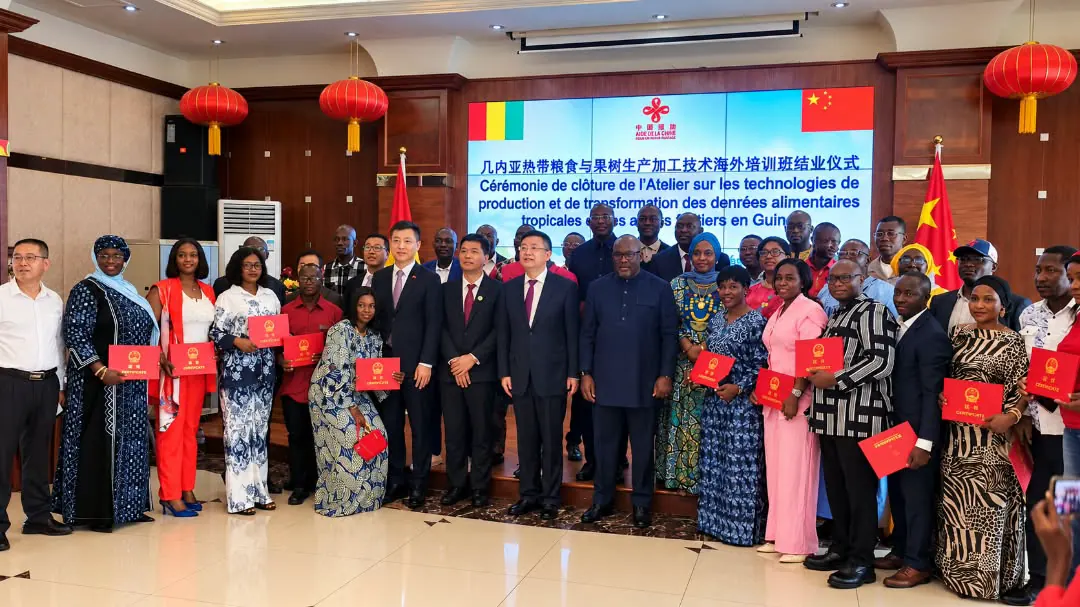
The Chinese Embassy in Guinea hosted a closing ceremony for a 30-day training workshop on tropical food production and processing technologies. The workshop, funded by Chinese cooperation, brought together Guinean agricultural officials to learn about production, conservation, and processing techniques. Professor Ou Wenjun, an expert in cereals at the Chinese Academy of Tropical Agricultural Sciences (CATAS), praised the participants' progress and the success of the training.
The training program covered various topics, including crop selection, flower and fruit management, pest and disease control, and agricultural mechanization. Participants also learned about post-harvest conservation, storage, and transportation techniques to reduce losses. The training was led by a team of five experts and an interpreter from CATAS, who tailored the modules to Guinea's agricultural realities and needs.
The training included practical exercises and field visits, including an immersion program at the Kindia experimental station, attached to the Guinean Institute of Agricultural Research (IRAG). Participants practiced various farming techniques, such as pruning and staking, on pineapple, banana, and mango plots. They also participated in cultural and sports activities, including traditional Chinese exercises and language classes.
Professor Ou Wenjun noted that the training helped build mutual understanding and friendship between China and Guinea. The experts also gained insight into the challenges facing Guinea's agricultural sector, including inadequate irrigation infrastructure, limited resources for pest management, and post-harvest losses. Ou Wenjun encouraged participants to apply their new skills to modernize and develop Guinea's agriculture.
Fanta Kaba, a participant, expressed gratitude to the organizers and Chinese experts, highlighting the knowledge gained in various areas, including agricultural production, mechanization, and post-harvest conservation. She emphasized that the training should lead to concrete changes in agricultural practices and promote innovation, value chain development, and sustainable agriculture.
Chinese Ambassador to Guinea Sun Yong stressed the importance of agriculture in national development and food security. He noted Guinea's potential for agricultural development, with fertile land and abundant rainfall, and highlighted China's measures to facilitate access for Guinean agricultural products to the Chinese market, including a zero-tariff policy and streamlined inspection procedures.
The training program is part of China's efforts to support Guinea's agricultural development, and the participants have pledged to apply their new skills to improve yields, reduce post-harvest losses, and promote agricultural transformation. The program aligns with Guinea's national development strategy, Simandou 2040, which prioritizes agricultural modernization.
Key points
- China has trained 30 Guinean agricultural officials in tropical food production and processing to help modernize the country's agricultural sector.
- The training program covered various topics, including crop selection, flower and fruit management, pest and disease control, and agricultural mechanization.
- China has introduced measures to facilitate access for Guinean agricultural products to the Chinese market, including a zero-tariff policy and streamlined inspection procedures.