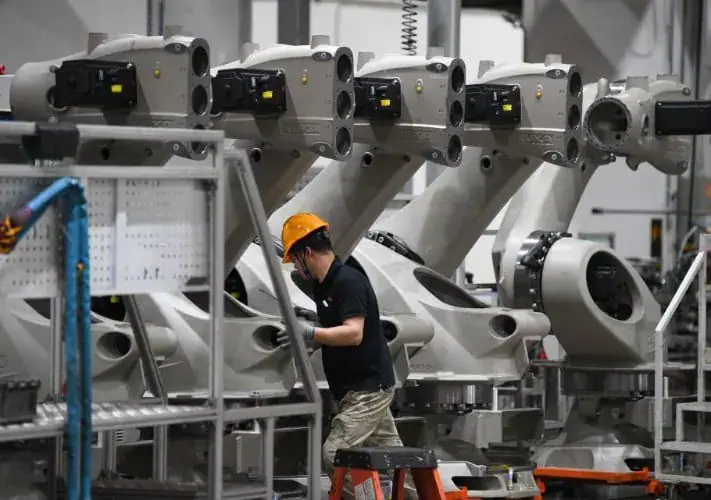
China's National Committee of Experts on Intelligent Manufacturing has released its 2026 annual report, summarizing the country's achievements in smart manufacturing over the past decade. The report highlights the characteristics of the next generation of smart manufacturing and forecasts ten major development trends. These trends include the shift towards cloud-based and intelligent industrial software, the application of embodied intelligence in production lines, and cooperation between intelligent agents.
The report notes that China's smart manufacturing level has reached a global leading position, with numerous smart factories, digital production lines, and intelligent equipment established. The country has also improved its organizational and coordination capabilities, as well as its ecosystem's competitiveness. China's smart manufacturing sector has made significant progress, with a focus on integrating advanced technologies into production processes.
The next generation of smart manufacturing is characterized by six key features, including the integration of virtual and real worlds, self-intelligence, flexibility, and speed. It also involves comprehensive coordination, human-machine co-governance, and environmental sustainability. These features are expected to transform the manufacturing sector, enabling more efficient and sustainable production processes.
Yang Hua Yong, a member of the Chinese Academy of Engineering and head of the International Alliance for Intelligent Manufacturing, explains that the next generation of smart manufacturing is a result of the deep integration of artificial intelligence and advanced manufacturing technologies. This integration enables manufacturing systems to perceive, decide, execute, and learn, transforming them from passive software executors to independent intelligent agents.
The application of embodied intelligence in production lines is expected to significantly improve manufacturing efficiency and productivity. This technology involves the integration of intelligent agents into production processes, enabling them to adapt to changing conditions and make decisions in real-time. China's smart manufacturing sector is poised to benefit from this technology, with many companies already exploring its potential applications.
The development of smart manufacturing in China has been driven by the country's efforts to upgrade its industrial capabilities and improve its global competitiveness. The sector has received significant investment and support from the government, with a focus on developing advanced technologies and promoting innovation. As a result, China has become a leader in smart manufacturing, with many companies adopting advanced technologies to improve their production processes.
The integration of embodied intelligence into production lines is a key trend in China's smart manufacturing sector, reflecting the country's focus on developing advanced technologies and promoting innovation. With its strong foundation in smart manufacturing, China is well-positioned to continue driving innovation and growth in the sector, both domestically and internationally.
Key points
- China's smart manufacturing sector is set to integrate embodied intelligence into production lines.