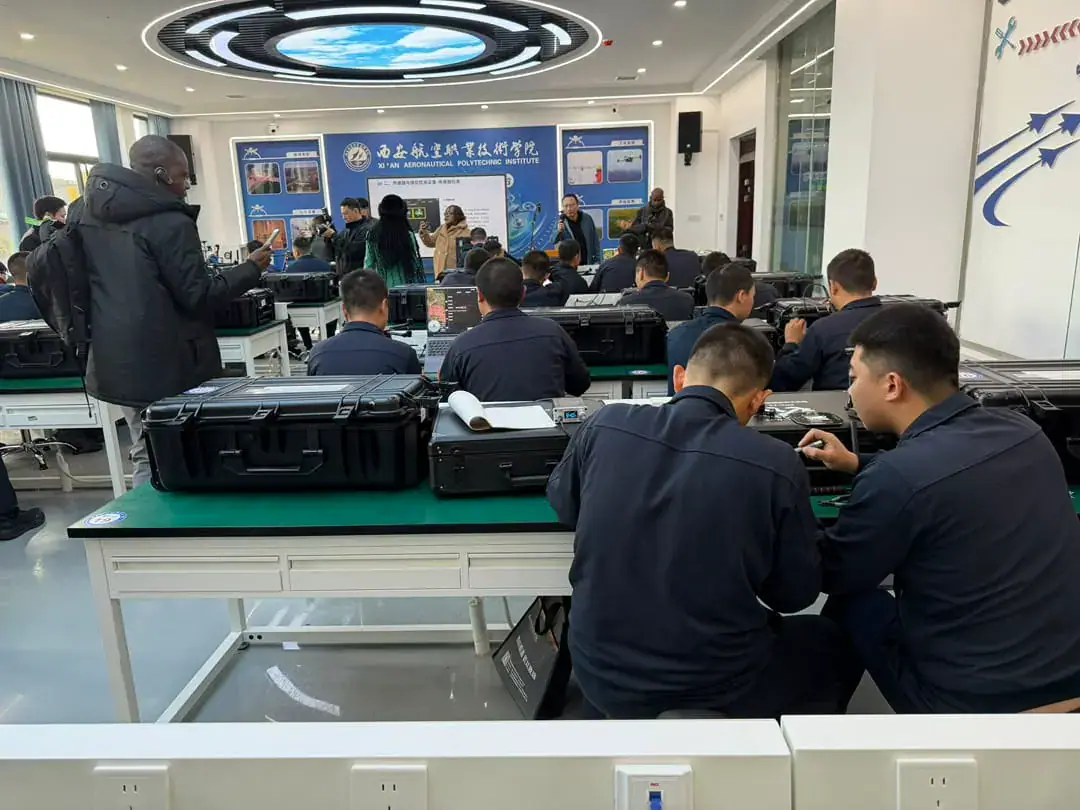
At the Qinling Workshop of Xi'an Aeronautical Vocational and Technical College in China, students are actively engaged in designing, developing, and assembling drones. This hands-on approach to learning is a reflection of the institution's emphasis on practical skills and innovation. The workshop, which is equipped with aircraft and helicopters, aviation equipment, and specialized training facilities, provides students with a unique learning experience that goes beyond traditional classroom instruction. The students' projects demonstrate their creativity, technical confidence, and curiosity, as they explore different drone technologies and develop solutions to practical problems.
The Qinling Workshop is part of Xi'an Aeronautical Vocational and Technical College, an institution that offers a wide range of programs in aviation, engineering, and technical education. The college's curriculum covers various disciplines, including aviation manufacturing, aircraft maintenance, and drone application technology. The breadth of these programs is significant, as it acknowledges that an aviation and manufacturing economy requires more than just pilots and aircraft engineers. It needs technicians, software developers, mechanics, and materials specialists, among others. The institution has developed specialized workshops, laboratories, and practical training facilities to support this approach.
The Chinese government's involvement in supporting vocational education is a key factor in the college's success. The college operates within China's publicly supported technical education system, with government funding and student support arrangements that make technical training more accessible. The tuition subsidies available to students are particularly noteworthy, as they help to make technical education more affordable for those who may not have been able to afford it otherwise. This investment in technical education reflects the government's understanding that producing skilled technicians is not just an educational responsibility, but also an economic and industrial priority.
The student population at the college is predominantly Chinese, with relatively few international students. This focus on developing the technical skills of China's own young population is significant, as it prepares them to contribute directly to the country's aviation, manufacturing, technology, and industrial sectors. The young people at the college are acquiring practical knowledge that can be translated into economic opportunities. A student who can design and assemble a drone, program its flight systems, and identify its possible applications is acquiring skills that can be applied in various industries.
The approach taken by Xi'an Aeronautical Vocational and Technical College offers valuable lessons for developing countries, including Nigeria. Education should not only prepare young people to search for jobs but also equip them with the capacity to create products, provide services, solve problems, and contribute to economic growth. A country that wants to industrialize needs more than university graduates; it needs a large pool of technically competent people who understand how things work and how to make them work.
Nigeria can learn from China's experience by strengthening the connection between what students learn in classrooms and the practical demands of the economy. Imagine a Nigerian polytechnic where agricultural technology students work with engineering and computer science students to develop drones for farmers. This kind of multidisciplinary innovation can produce solutions that would otherwise be difficult to achieve. To achieve this, Nigerian institutions need to invest more deliberately in practical training facilities, such as functioning laboratories, workshops, and machinery.
To implement this approach, several steps can be taken. First, institutions need to invest in practical training facilities, such as laboratories and workshops. Second, partnerships between educational institutions and industry should be strengthened, with companies participating in curriculum development, providing equipment, and offering internships. Third, multidisciplinary innovation should be encouraged, bringing students from different disciplines together to work on projects. Finally, government support for technical education is crucial, as it can help make technical training more accessible and affordable for students.
Key points
- China's investment in technical education reflects an understanding that producing skilled technicians is not just an educational responsibility, but also an economic and industrial priority.
Reporting sources
- CHINA DIARIES: Where Students Build the Future · Daily Trust