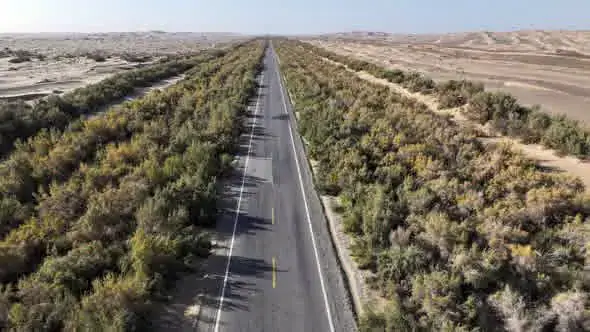
In northwest China's Xinjiang Uyghur Autonomous Region, a 562-kilometer highway traversing the Taklamakan Desert was once predicted to be buried under sand and abandoned. However, a 436-kilometer green belt comprising over 20 million plants has been established to safeguard the route. The Tarim Highway, which opened in October 1995, created an energy corridor through the desert. To stabilize the sand and prevent wind erosion, vegetation was necessary. The region's harsh conditions include less than 11 millimeters of annual rainfall and abundant but highly saline groundwater.
The groundwater in the area has a high salt concentration of 27.8 grams per liter, making it challenging for most plants to thrive. To find suitable species, the Tarim oilfield, a significant producer of oil and gas in the region, and the Xinjiang Institute of Ecology and Geography under the Chinese Academy of Sciences launched a plant selection program. Researchers identified the tamaris, haloxylon, and calligonum as promising desert shrubs. These robust plants were used to create a protective belt along the highway.
The protective belt project began in August 2003, coinciding with the establishment of the Tazhong botanical garden. The garden introduced nearly 500 plant species, with over 230 thriving in the area. The acclimation process, which can take three to five years, was crucial in determining the survival of each species. According to Chang Qing, a senior engineer at the institute, the selected and acclimated plants can be irrigated directly with saline water.
By 2005, when the project was completed, the plants had formed an ecological barrier over 70 meters wide, with a survival rate of more than 85%. The vegetation in the protective belt has grown to an average height of over 2 meters. The green corridor has also become a habitat for various wildlife, including over 100 bird species, as well as hares, gerbils, and sand foxes.
The successful establishment of the green belt has helped to stabilize the sand and prevent wind erosion along the highway. The project demonstrates China's efforts to protect its environment and promote sustainable development in the region. The use of saline-tolerant plants has provided a solution for areas with high salt concentrations in the soil.
The Taklamakan Desert is known for its extreme climate and limited vegetation. The creation of the green belt has not only protected the highway but also provided a habitat for local wildlife. The project serves as an example of China's commitment to environmental conservation and sustainable development.
The green belt has become an essential component of the region's ecosystem, providing a natural barrier against the desert's harsh conditions. The project's success has paved the way for similar initiatives in other arid regions, promoting environmental protection and sustainable development.
Key points
- Over 20 million plants were used to create the 436-kilometer green belt.
- The green belt has a survival rate of over 85%.
- The project has helped to establish a habitat for over 100 bird species and various other wildlife.
Reporting sources
- Comment la Chine a dompté le désert · Agence Nigérienne de Presse