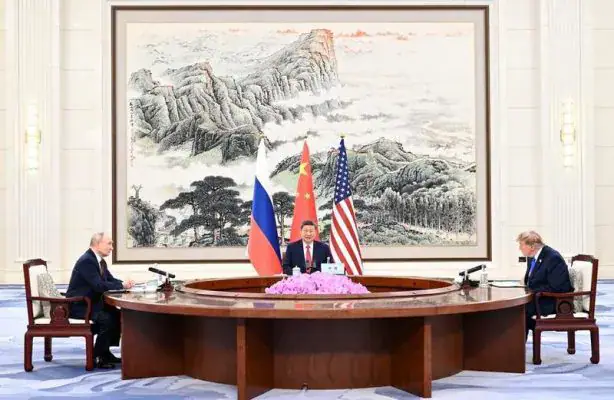
On November 18, 2026, Chinese President Xi Jinping, Russian President Vladimir Putin, and US President Donald Trump held a trilateral meeting in Shenzhen, China, on the sidelines of the Asia-Pacific Economic Cooperation (APEC) summit. The meeting, which lasted around 80 minutes, marked a significant shift in global diplomacy. According to Chinese Foreign Ministry spokesperson Mao Ning, the three leaders had a "deep exchange of views" on maintaining global peace and promoting strategic stability.
The meeting resulted in a joint declaration, titled "Declaration of the Heads of State of China, Russia, and the United States in Favor of Peace." The declaration outlined four key commitments, including promoting reform of the United Nations to better address global challenges, increasing production and supply of refined petroleum products, respecting the principle of state consent and immunity of government officials, and preventing nuclear war.
The declaration's third point, which emphasizes the importance of state consent and immunity of government officials, is seen as a significant concession to Russian President Vladimir Putin, who is facing an arrest warrant from the International Criminal Court. The declaration also highlights the three leaders' commitment to dialogue on reducing nuclear risks and preventing proliferation.
Each leader appeared to gain from the meeting, with Putin achieving a major diplomatic victory by being welcomed as an equal by the US and Chinese leaders. Trump, who has faced criticism at home, used the meeting to showcase his ability to engage in dialogue with his rivals. Xi Jinping, the host of the summit, reinforced China's central role in global affairs and secured a more stable relationship with Washington.
However, the meeting has raised concerns among traditional US allies, who feel excluded from the discussions. The final declaration's silence on ongoing conflicts, such as those in Ukraine and the Middle East, has sparked fears of a new "Yalta" agreement, where the fate of nations is decided without their input.
European leaders have expressed skepticism about the meeting's outcome, with French Foreign Minister Jean-Noël Barrot stating that the three leaders did not agree on anything concrete. In response, Putin claimed that Europe had marginalized itself by opting for war and trying to inflict a strategic defeat on Russia.
The meeting has significant implications for global governance, suggesting a shift towards a more multipolar world order, with a concert of three nuclear powers making key decisions. While the declaration lacks a clear roadmap for disarmament or conflict resolution, it sends a clear message that the global balance of power will be negotiated in a much more restricted forum.
Key points
- The trilateral meeting marks a significant shift in global diplomacy, with the leaders of China, Russia, and the US committing to promote peace and stability through a joint declaration.
- The meeting has raised concerns among traditional US allies, who feel excluded from the discussions and fear a new "Yalta" agreement.
- The declaration's outcome has significant implications for global governance, suggesting a shift towards a more multipolar world order.
Reporting sources
- À Shenzhen, le « directoire des trois » redessine les contours de l’ordre mondial · Le Jeune Indépendant