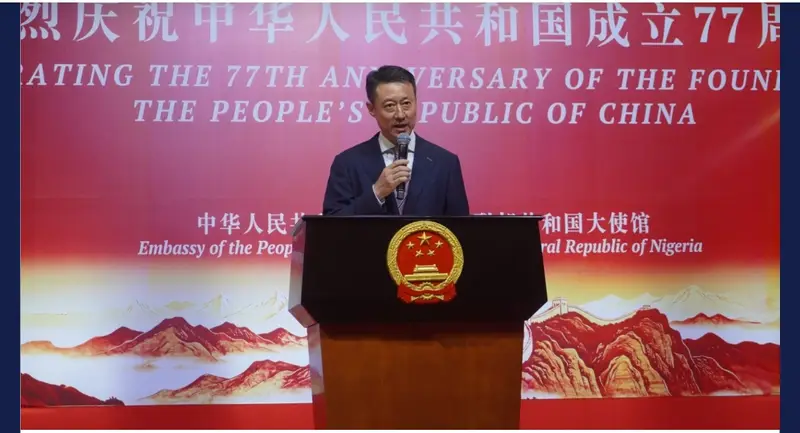
Nigeria and China have strengthened their bilateral relations, with trade between both countries reaching $18 billion in the first half of 2026. This development presents fresh opportunities for economic expansion, job creation, and stronger commercial ties between both countries. The Minister of Power, Joseph Olasunkanmi Tegbe, disclosed the figure while speaking on behalf of President Bola Ahmed Tinubu at a ceremony in Abuja marking the 77th anniversary of the founding of the People’s Republic of China.
According to Tegbe, bilateral trade between Nigeria and China stood at approximately $28 billion at the end of 2025 and has continued to expand. Nigeria’s exports to China have also recorded significant growth. Tegbe noted that Nigeria and China have maintained a strong partnership since the establishment of diplomatic relations on February 10, 1971. The cooperation between both countries extends across infrastructure, healthcare, education, technical training, and trade.
The relationship between Nigeria and China reached a new level in September 2024 when President Tinubu and Chinese President Xi Jinping elevated bilateral ties to a Comprehensive Strategic Partnership during the Forum on China-Africa Cooperation (FOCAC) Summit in Beijing. Tegbe commended China’s contributions to Nigeria’s infrastructure development, particularly in railway modernisation and power projects. He identified electricity, renewable energy, and local manufacturing of power equipment as critical areas for further cooperation.
Tegbe stressed the need for investments that would strengthen local capacity and develop Nigerian technical expertise. He welcomed China’s zero-tariff treatment for 53 African countries, describing the policy as an opportunity for Nigerian producers and exporters to gain greater access to the Chinese market. The minister reaffirmed Nigeria’s commitment to the One China Principle, recognising the People’s Republic of China as the sole legal government representing China.
The Chinese Ambassador to Nigeria, Yu Dunhai, described the relationship between China and Nigeria as an important pillar of China-Africa cooperation. Yu reflected on his two years of diplomatic service in Nigeria and said his visits to different cities and rural communities had deepened his appreciation of Nigerians’ resilience, optimism, and entrepreneurial spirit. He said China remained committed to its modernisation drive and to contributing to global development despite prevailing economic challenges.
Yu disclosed that China’s economy grew by 4.7 per cent in the first half of the year, supported by innovation in areas including artificial intelligence, robotics, pharmaceuticals, and renewable energy. He highlighted China’s growing engagement in global governance and its support for Africa’s development aspirations. Yu said China’s zero-tariff policy covering 53 African countries was designed to promote African exports, accelerate industrialisation, and support the continent’s economic development.
Yu added that China would continue to support African integration, self-reliant development, and modernisation through FOCAC and other strategic cooperation platforms. He said increased economic cooperation, infrastructure development, people-to-people exchanges, and stronger development partnerships would further consolidate China-Nigeria relations. The envoy’s statement underscores the growing partnership between China and Nigeria, with both countries seeking to deepen their cooperation in various sectors.
Key points
- The trade between Nigeria and China has reached $18 billion in the first half of 2026.
- Nigeria and China have maintained a strong partnership since the establishment of diplomatic relations on February 10, 1971.
- China’s zero-tariff treatment for 53 African countries presents an opportunity for Nigerian producers and exporters to gain greater access to the Chinese market.