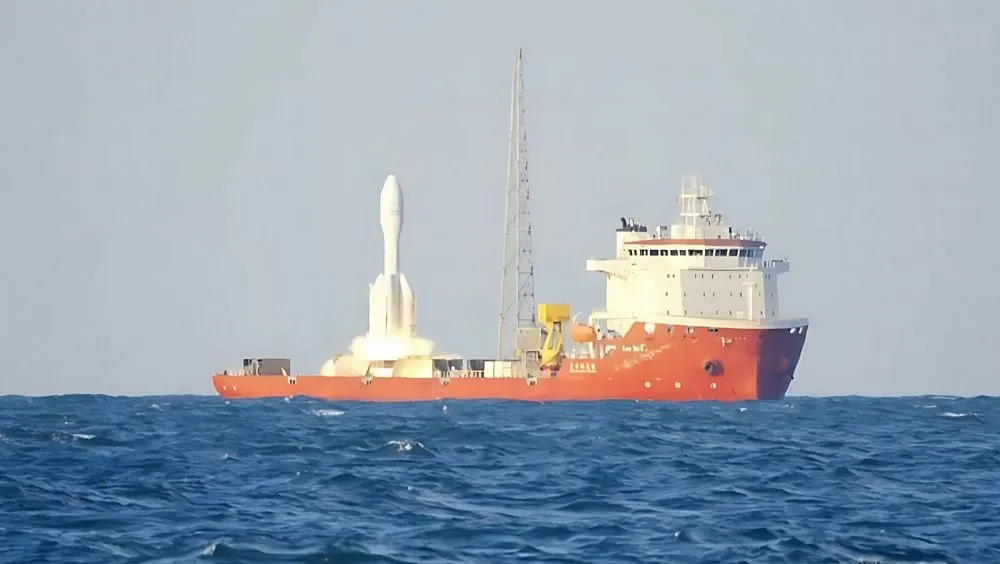
China has achieved a significant milestone in its space exploration program by launching nine satellites into their designated orbits from waters off the coast of Shanghai. This launch marked the world's first mobile sea-based launch of a low-Earth orbit satellite constellation for the deployment of a broadband internet network. The successful mission was carried out by the Gravity-1 Y3 launch vehicle.
The launched satellites included eight from the Qianfan constellation, also known as the "Constellation of a Thousand Sails," a project aimed at deploying a global low-Earth orbit satellite system to provide high-speed internet access. The ninth satellite was an Enhanced Ultra High Throughput (EUHT) technology test satellite. These satellites were delivered to their intended orbits, setting two new Chinese records for a single sea-based launch.
The Gravity-1 Y3 launch vehicle demonstrated its capability by exceeding a payload mass of 3 tonnes and reaching an injection altitude of 800 kilometres. This confirmed that the sea-based launch method is fully suitable for medium- and large-sized satellite payloads. The Gravity-1 rocket is a solid-fuelled rocket with a maximum payload capacity of 6.5 tonnes to low Earth orbit.
This was the second mobile launch of the Gravity-1 rocket from the Far East, with the previous mission taking place just 56 days prior. The rocket successfully operated in maritime conditions characterised by high temperatures, humidity, and salt fog. This launch was significant as it was the first dedicated entirely to a mega-constellation of low-Earth-orbit internet satellites.
The development of the Gravity-2, a large reusable liquid-fuelled rocket, is also progressing rapidly. The Gravity-2 is expected to provide a payload capacity of 21.5 tonnes to low Earth orbit and is set to make its debut shortly. This will further enhance China's capabilities in launching satellites and other spacecraft.
China's space program has been making significant strides in recent years, with a focus on developing a global low-Earth orbit satellite system. The Qianfan constellation project aims to provide high-speed internet access to users around the world. The successful launch of the nine satellites marks a major step towards achieving this goal.
The launch of the satellites from the sea-based platform highlights China's growing expertise in space exploration and its ability to adapt to different launch conditions. The mission demonstrates China's commitment to expanding its presence in space and providing innovative solutions for global communication needs.
Key points
- China launched nine satellites into orbit from waters off Shanghai, marking the world's first mobile sea-based launch of a low-Earth orbit satellite constellation for broadband internet.
- The launched satellites included eight from the Qianfan constellation and one Enhanced Ultra High Throughput (EUHT) technology test satellite.
- The Gravity-1 Y3 launch vehicle set two new Chinese records for a single sea-based launch, exceeding a payload mass of 3 tonnes and reaching an injection altitude of 800 kilometres.