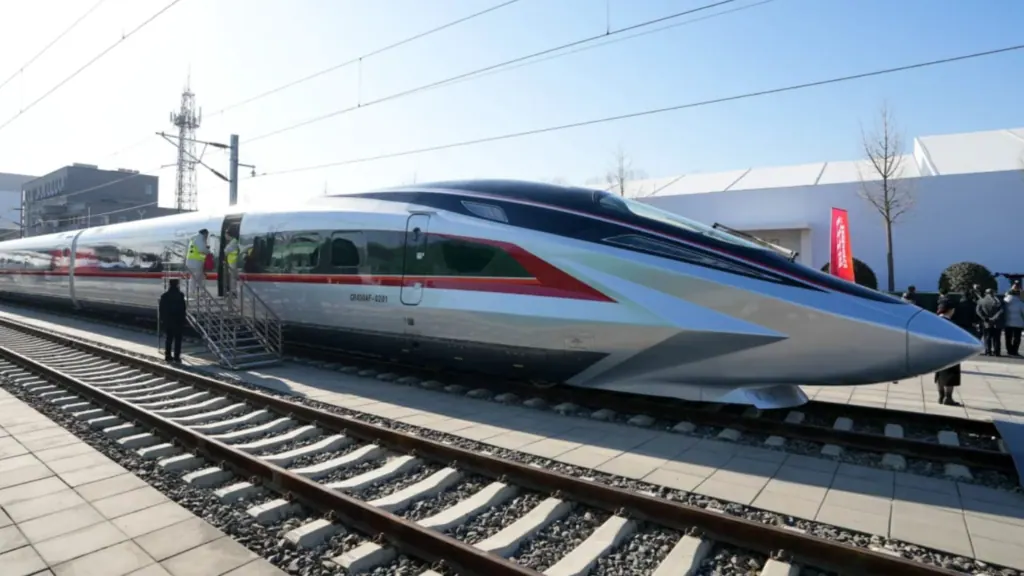
China has inaugurated four major high-speed rail line sections, further solidifying its position as the world's largest high-speed rail network operator. The new lines connect Xiong'an in Hebei Province to Shangqiu in Henan Province, Xi'an to Ankang in Shaanxi Province, Yichang to Xingzhan in Hubei Province, and Harbin to Yichun in Heilongjiang Province. These additions span northern, northwestern, central, and northeastern China.
The introduction of these high-speed rail lines is expected to significantly improve inter-regional transportation, promote economic development, and enhance connectivity across China. The expanded network will facilitate travel for millions of passengers, fostering greater mobility and economic growth. According to official data, by the end of 2025, China's operational rail network had reached 165,000 kilometers.
The new high-speed rail lines are part of China's ambitious plan to expand its rail network. By 2030, the country aims to have 180,000 kilometers of operational rail lines, with approximately 60,000 kilometers of high-speed rail. This expansion will not only improve domestic transportation but also support China's growing economy. The high-speed rail network has become a vital component of China's transportation infrastructure.
China's high-speed rail network has been rapidly expanding over the years, with a focus on connecting major cities and regions. The new lines will reduce travel times and increase the efficiency of transportation, making it easier for people to travel and for goods to be transported. This, in turn, is expected to boost economic growth and development.
The development of China's high-speed rail network has been driven by significant investment and technological advancements. The country has made substantial progress in building and operating high-speed rail lines, with many lines already in operation. The expansion of the network is expected to continue, with new lines and sections being added regularly.
China's commitment to expanding its high-speed rail network reflects its dedication to improving transportation infrastructure and promoting economic growth. The new lines will have a positive impact on the country's development, enhancing connectivity and facilitating travel. As the network continues to grow, it is likely to play an increasingly important role in China's economy.
The launch of the four new high-speed rail lines marks a significant milestone in China's transportation development. With its extensive network, China is well on its way to achieving its goal of having 60,000 kilometers of high-speed rail lines by 2030. The expanded network will bring numerous benefits, including improved connectivity, increased mobility, and enhanced economic growth.
Key points
- China has launched four new high-speed rail lines, expanding its vast network and enhancing regional connectivity.
- The new lines connect major cities and regions, including Xiong'an, Shangqiu, Xi'an, Ankang, Yichang, Xingzhan, Harbin, and Yichun.
- China aims to have 180,000 kilometers of operational rail lines by 2030, with approximately 60,000 kilometers of high-speed rail.