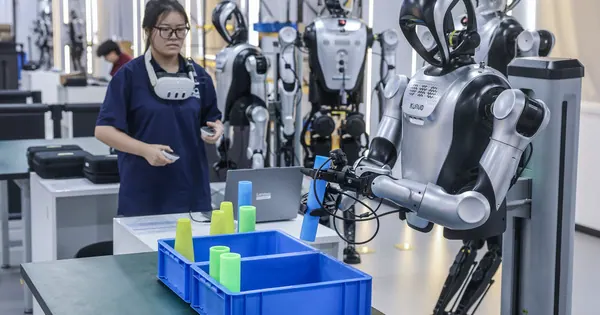
China has recently announced 11 new occupations and 23 new work types, reflecting the country's efforts to drive industrial upgrading and economic development through emerging professions. The new jobs, which include digital twin engineering technicians, embodied intelligent robot application technicians, and industrial product digital modelers, are expected to create new career opportunities and meet the demands of a rapidly changing job market. These emerging professions are also aligned with China's goals for green transformation and digital economy growth.
The introduction of new occupations is part of China's efforts to deepen industry-education integration and provide students with hands-on experience in cutting-edge technologies. For example, a recent AI-focused training camp held by the Huawei ICT Academy at Beijing University of Posts and Telecommunications (BUPT) provided over 70 students with integrated training and hands-on practice on AI fundamentals, AI operator development, and open-source large models. Such initiatives aim to cultivate engineering-oriented AI talents equipped with a solid theoretical foundation, practical skills, and an innovative spirit.
The new jobs in the green-transformation sector, such as microgrid administrators, hydrogen fuel cell manufacturing technicians, and water electrolysis hydrogen production operators, reflect China's talent-demand on its quest for comprehensive green transformation in both the economy and social development. The emergence of modern service occupations, including sports data analysts, airport airspace clearance inspectors, and low-altitude logistics operators, is also expected to drive growth in the service industry. These new occupations mirror the accelerated iteration of China's industrial structures and expanding gaps for talents equipped with new skills in the job market.
According to the Digital China Development Report (2025), the added value of core digital economy industries accounted for more than 10.5 percent of China's GDP, with the core AI industry exceeding 1.2 trillion yuan (about 177.8 billion U.S. dollars) in scale. However, talent gaps continue to expand, with China expected to face a sizable shortage of workers with digital skills for some time. McKinsey & Company forecasts that China will require 6 million AI professionals by 2030, but could face a shortfall of 4 million.
To address the talent gap, the Ministry of Education has released the 2026 undergraduate major catalog, which includes new majors such as future robots and embodied intelligent robots. The Ministry of Education and four other departments have also issued an "AI + Education" action plan, proposing to make AI a public fundamental course in colleges and universities. Universities are partnering with enterprises to cultivate talent adapted to new business forms and industrial upgrading, such as the AI training camp co-hosted by BUPT and Huawei.
The Chinese government has been dynamically updating its occupational classification catalog, issuing eight batches of 121 new occupations since 2019. China has so far recognized 113 digital occupations and 142 green occupations. These moves are anticipated to help promote employment and entrepreneurship, offer workers more diverse career paths, and better match talent supply with job demand. According to Li Chang'an, a researcher at the Academy of China Open Economy Studies, the introduction of new occupations aligns with ongoing industrial transformation and new trends in the labor market.
During the 15th Five-Year Plan (2026-2030) period, China aims to explore new employment space in the digital economy, green economy, and silver economy. The Ministry of Human Resources and Social Security and other government departments will continue to release new occupations and work types to meet the demands of industrial transformation and economic development. Key initiatives, such as the "AI + Education" action plan and industry-education integration, are expected to drive growth in emerging professions and address talent gaps in the job market.
Key points
- China introduces 11 new occupations and 23 new work types to drive industrial growth
- New jobs in green-transformation sector reflect China's talent-demand for comprehensive green transformation
- China aims to explore new employment space in digital economy, green economy, and silver economy during 15th Five-Year Plan period