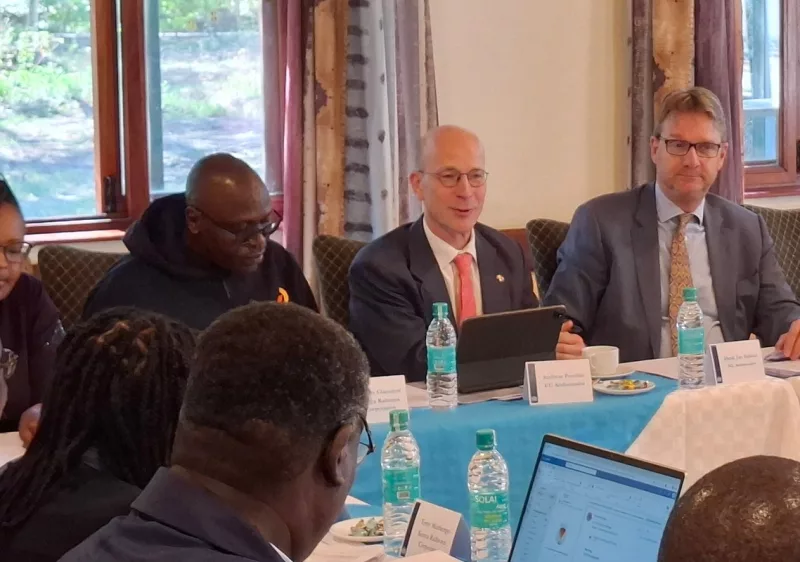
China and the European Union are stepping up their efforts to strengthen economic ties with Kenya, with a focus on the agricultural sector. This competition is becoming increasingly visible in Naivasha, where the EU is supporting initiatives to connect Kenyan flowers and vegetables to international markets. Meanwhile, China is opening up its vast consumer market to more African agricultural products. The EU's efforts are part of its Global Gateway initiative, which aims to improve connectivity and supply chains between Kenya and international markets.
On October 6, EU Ambassador Andreas Peschke visited Naivasha for a meeting of the Steering Committee of the FRESH Northern Corridor Project, a collaboration between Kenya, the Netherlands, and the EU. During the meeting, Peschke emphasized the need to get Kenyan products to international markets quickly, reliably, and sustainably. He also highlighted Kenya's flower industry, describing Kenyan flowers as "world-class" and noting that Europe is the largest market for Kenyan flowers, vegetables, and foliage.
The European push comes as China is making its own move to deepen access for Kenyan agricultural products. On September 24, Chinese Ambassador Guo Haiyan led a delegation to Naivasha, where they toured Vertical Agro Group, an exporter of fruits and vegetables. The company's packhouse is linked to the Naivasha Inland Container Depot, which is connected to the Chinese-built Standard Gauge Railway (SGR). This allows refrigerated produce to move by rail towards the Port of Mombasa.
During the visit, Amb Guo highlighted the importance of infrastructure and market access, citing the Mombasa-Nairobi-Naivasha railway as a key factor in unlocking growth in Kenya's agricultural sector. He also noted that China's zero-tariff policy for African products is expanding opportunities for Kenyan products in China. Since May 1, China has introduced zero-tariff treatment for products from 53 African countries, including Kenya.
Early trade figures suggest that Kenyan exporters are responding to China's zero-tariff policy. Between May and August, Kenya exported 1.71 million kilogrammes of unroasted green coffee to China, up from 712,610 kilogrammes during the same period in 2025. The value of Kenyan coffee shipments to China nearly doubled, rising from about $7.43 million to $14.67 million during the same period.
Kenyan avocado exports also recorded strong growth, with the value of shipments rising from about $4.03 million to $6.44 million between May and August 2025 and the same period this year. Combined, the value of coffee and avocado exports to China increased from about $11.47 million to $21.11 million. These figures indicate the potential impact of China's tariff concessions on Kenyan agricultural exports.
The competition between China and the EU is not limited to the agricultural sector. The two sides are also vying for influence in Kenya's infrastructure sector, with China financing and constructing major components of Kenya's transport infrastructure, including the Standard Gauge Railway. The EU, on the other hand, is backing improvements along the Northern Corridor, which links Mombasa with Kenya's landlocked neighbours.
Key points
- The EU and China are competing to deepen economic ties with Kenya, with a focus on the agricultural sector.
- The EU is supporting initiatives to connect Kenyan flowers and vegetables to international markets, while China is opening up its vast consumer market to more African agricultural products.
- Kenya's agricultural exports to China have recorded strong growth, with coffee and avocado exports increasing significantly since China introduced its zero-tariff policy.