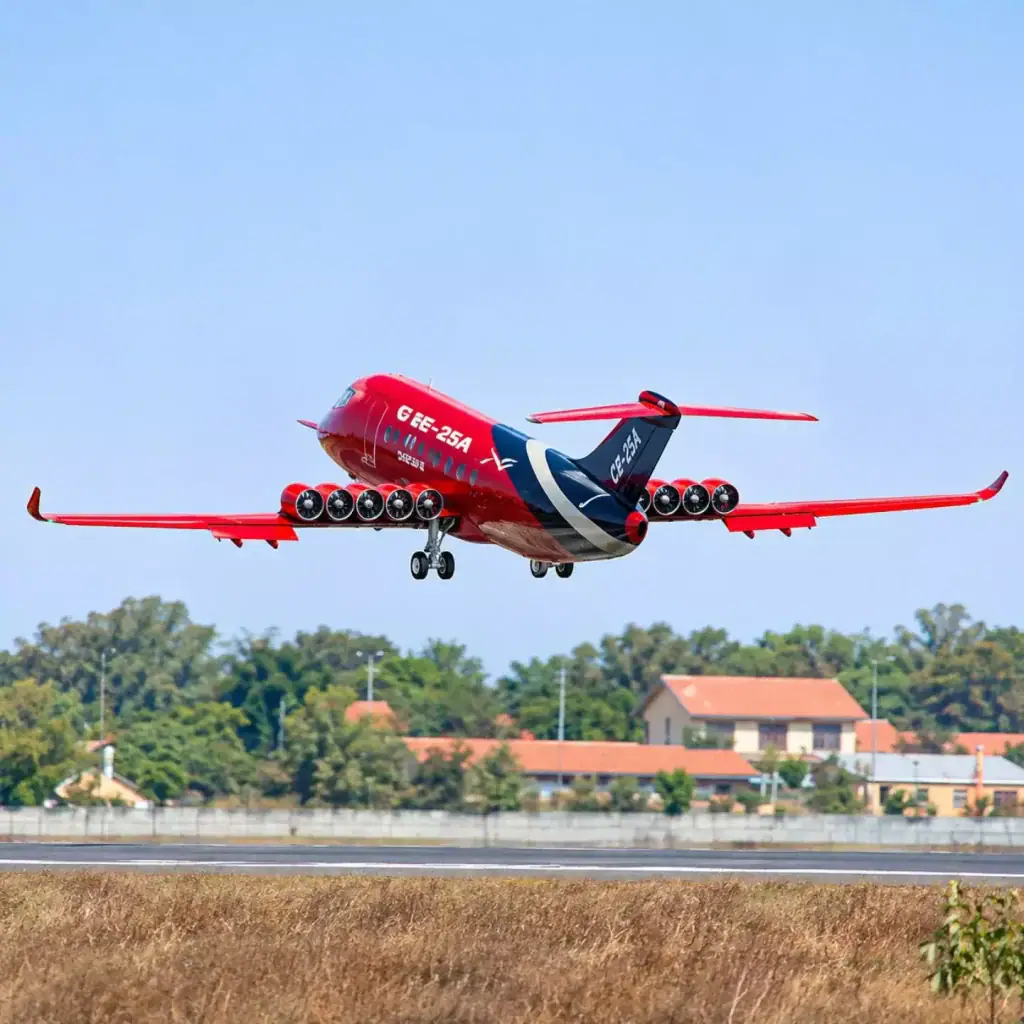
China's Commercial Aircraft Corporation of China (COMAC) has successfully completed the first manned flight test of its electric passenger aircraft, the CE-25A. The test flight took place on November 14, 2026, in Binzhou, Shandong province, marking a significant milestone in the development of electric aviation technology. The aircraft carried three people, including two pilots and a test engineer, and stayed airborne for 16 minutes and 38 seconds.
The CE-25A aircraft flew a distance of approximately 60.4 kilometers before landing safely. According to COMAC, the flight was conducted smoothly, with all performance indicators within expected ranges. The CE-25A is designed to carry 19 passengers and has a maximum takeoff weight of 10 tons. It is equipped with 10 small electric motors that power specialized fans installed on its wings, five on each side.
The CE-25A has a top speed of up to 300 kilometers per hour and a range of 400 kilometers per flight. Before the manned flight test, the CE-25A had completed 19 unmanned flight tests since its first autonomous flight on February 2, 2026. The project was developed in collaboration with COMAC, battery manufacturer CATL, and Shanghai Jiao Tong University, among other partners.
The electric passenger aircraft is primarily aimed at providing short-distance commercial flights between cities. The use of electric power is expected to reduce dependence on fossil fuels, lower operating costs, and decrease emissions produced by engines during flight. However, despite the successful test flight, the CE-25A has not yet begun commercial passenger services.
The aircraft still needs to complete safety certification procedures and obtain approval from Chinese aviation authorities. According to reports, the authorities have already received COMAC's application for certification. The success of the CE-25A test flight demonstrates China's efforts to develop new aviation technologies, as the world continues to seek alternative solutions to reduce reliance on fossil fuels in the transportation sector.
The development of electric aircraft like the CE-25A is part of a broader push to reduce emissions and operating costs in the aviation industry. Electric propulsion systems have the potential to significantly decrease the environmental impact of air travel, which currently accounts for a substantial portion of global greenhouse gas emissions.
As the aviation industry continues to evolve, electric and hybrid-electric aircraft are expected to play a larger role in reducing emissions and operating costs. The CE-25A's successful test flight marks an important step towards making electric aviation a reality, and COMAC's progress will be closely watched by the industry and regulators in the coming months.
Key points
- The CE-25A electric passenger aircraft completed its first manned flight test on November 14, 2026, in Binzhou, Shandong province, China.
- The aircraft flew for 16 minutes and 38 seconds, covering a distance of approximately 60.4 kilometers.
- The CE-25A is designed to carry 19 passengers and has a top speed of up to 300 kilometers per hour.