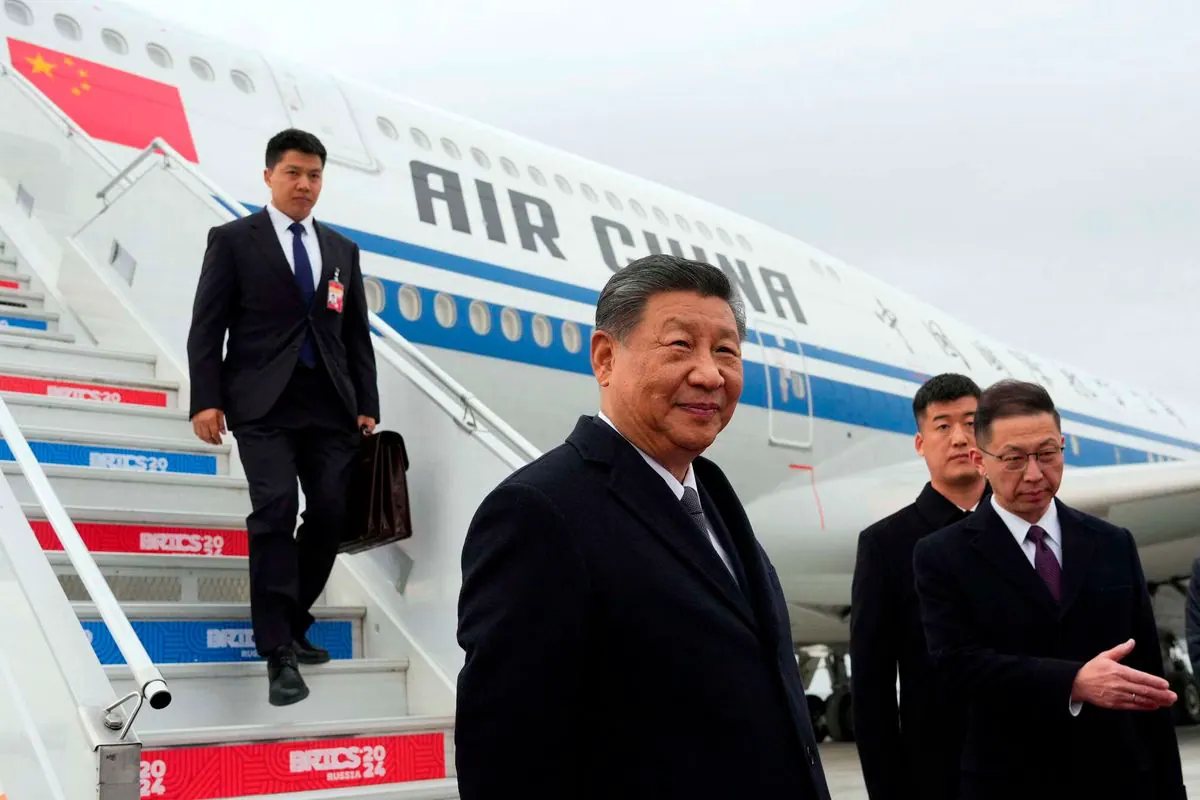
China is set to celebrate its 77th National Day on October 1, commemorating the founding of the People's Republic of China in 1949. This year's celebration carries significant weight as China continues to foster its partnership with Africa. The recent 18th Brics Summit in New Delhi saw leaders of the expanded Brics family conclude discussions, with India handing over the Brics chairmanship to China for 2027. China's President Xi Jinping has termed this as the beginning of the bloc's 'third golden decade' of cooperation.
The conversation about development, partnership, and the growing confidence of the Global South in shaping its own future began long before Brics and China's Belt and Road Initiative. It started with solidarity between newly independent nations seeking a greater voice in the international system. In 1971, African countries played a crucial role in restoring China's seat at the United Nations through Resolution 2758. Twenty-six African states voted in favor of the resolution, showcasing the continent's growing diplomatic influence during the post-colonial era.
China has never forgotten the support it received from African countries during its return to the UN. President Xi Jinping emphasized the deep-rooted friendship between China and Africa during the Forum on China-Africa Cooperation Johannesburg Summit in 2015. He stated that China and Africa are true friends in times of hardship, and such friendships must never be forgotten. China has consistently described Africa as 'a sincere friend and reliable partner.'
The China-Africa partnership has evolved into one of the world's largest South-South partnerships. Since 1991, China's foreign minister's first overseas visit of the year has always been to an African country. In 2026, Foreign Minister Wang Yi visited Ethiopia, Somalia, Tanzania, and Lesotho from January 7-12, continuing the tradition. The relationship has grown from diplomatic solidarity to extensive development cooperation.
China's development story is a testament to its partnership with Africa. In 1949, China's economy was worth only about $40-50 billion, with a GDP per capita of just $23. Today, it is the world's second-largest economy. China's engagement with Africa is an extension of their shared history, translated into development cooperation. The Global Development Initiative (GDI) proposed by President Xi Jinping in 2021 has led to over 2,000 development projects and initiatives across participating countries.
Across Africa, Chinese companies have participated in constructing railways, highways, deep-water ports, hydro-power stations, airports, and industrial parks. China has become one of the most significant builders of physical infrastructure across Africa in the twenty-first century. Additionally, China has remained Africa's largest bilateral trading partner for over 15 consecutive years, with trade growing from approximately $10 billion in 2000 to well over $290 billion annually.
The next chapter of the China-Africa partnership is increasingly multilateral. At the Brics Summit in New Delhi, President Xi Jinping called for a stronger commitment to multilateralism, people-centered development, and deeper cooperation in areas such as artificial intelligence and special economic zones. As China prepares to chair Brics in 2027, the significance of that vision will lie in its implementation.
Key points
- China's partnership with Africa is built on a history of solidarity and mutual support.
- The China-Africa partnership has grown into one of the world's largest South-South partnerships.
- China has become one of the most significant builders of physical infrastructure across Africa.