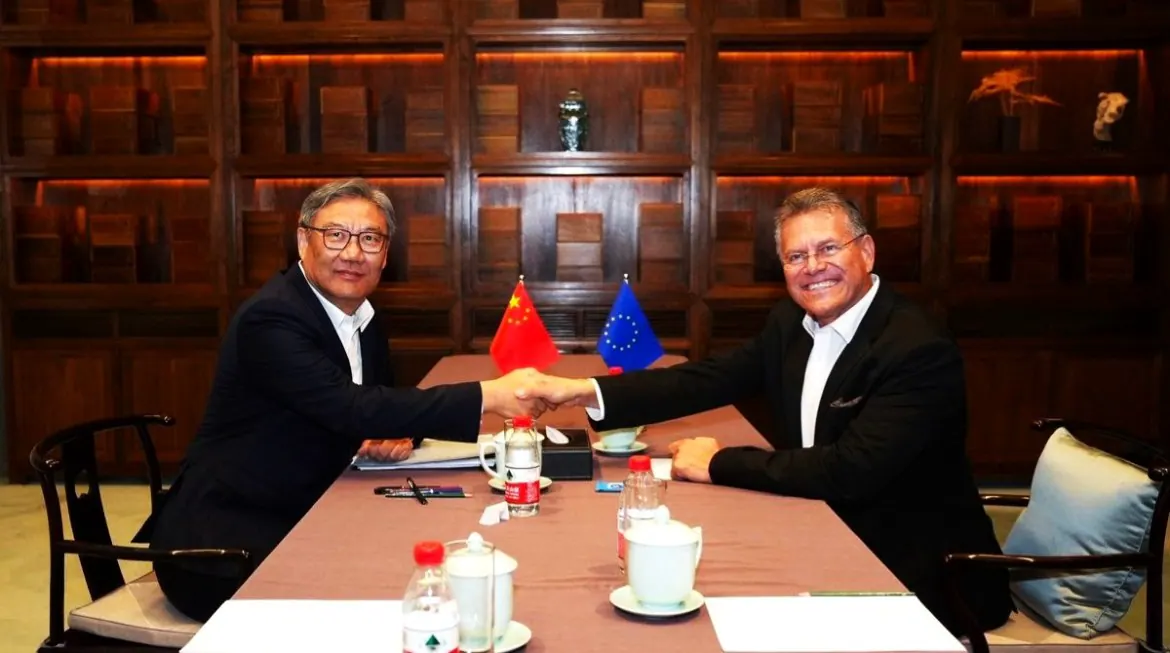
China and the European Union have reached a significant milestone in their trade relations, agreeing on 16 resolutions across four key areas following two days of talks in Beijing on October 8-9. The joint statement, released by China's Ministry of Commerce on October 9, outlined the outcomes of the second Trade and Investment Consultations mechanism meeting between China and the EU. Chinese Commerce Minister Wang Wentao and European Commissioner for Trade and Economic Security Maroš Šefčovič led the discussions.
The talks covered trade and investment balancing, export controls, intellectual property rights, and World Trade Organization (WTO) reform. Both sides pledged to manage differences within the WTO framework and work toward more balanced economic ties. They also agreed to hold a ministerial-level video conference in January 2027 and the next consultation meeting in March. The outcomes reflect a shared recognition in Beijing and Brussels that trade disputes must be managed without derailing broader economic relations.
The 16 resolutions cover a range of areas, including trade and investment balance, export controls, intellectual property, and WTO reform. In the area of trade and investment balance, the two sides agreed to explore the possibility of reducing tariffs on certain goods within the framework of WTO rules. They also reached an understanding on trade in hybrid vehicles and will continue their dialogue on market access for medical devices. The EU welcomed China's measures to expand imports of EU medical devices.
The two sides also agreed to strengthen communication and cooperation under the trade-monitoring mechanism and make further active use of dialogue mechanisms to enhance mutual understanding. They recalled the guidance document on price undertakings in the electric-vehicle anti-subsidy case and will continue the related procedures concerning company price undertakings and the review in that case. China will expedite its work to recognize the regionalization principle for eligible EU member states.
In the area of export controls, the two sides reiterated the need to further strengthen their dialogue and welcomed stronger communication and exchanges on their respective export-control policies. They recognized the importance of enhancing the predictability and stability of global industrial and supply chains. China is willing to continue facilitating the approval of export licenses for rare earths and permanent magnets to the EU through the “green channel” mechanism.
The two sides also made progress on intellectual property issues, agreeing to continue cooperating to resolve relevant issues and set interim targets. They focused on effective and fair intellectual-property protection and enforcement, as well as greater transparency and predictability. The China–EU Intellectual Property Working Group will monitor progress. Both sides agreed to further strengthen bilateral communication and cooperation on WTO reform in an open and constructive manner.
The 16 resolutions mark progress in consultation, though their substantive impact remains to be seen. The key challenge now is translating these understandings into concrete action. Sustained high-level communication gives both sides room to prevent disputes from escalating and identify areas for practical cooperation. At a time of growing protectionism and global economic uncertainty, maintaining stable China-EU trade relations serves the interests of both sides.
Key points
- China and the EU agreed on 16 outcomes across four key areas, including trade and investment balancing, export controls, intellectual property rights, and WTO reform.
- The two sides pledged to manage differences within the WTO framework and work toward more balanced economic ties.
- The outcomes reflect a shared recognition in Beijing and Brussels that trade disputes must be managed without derailing broader economic relations.