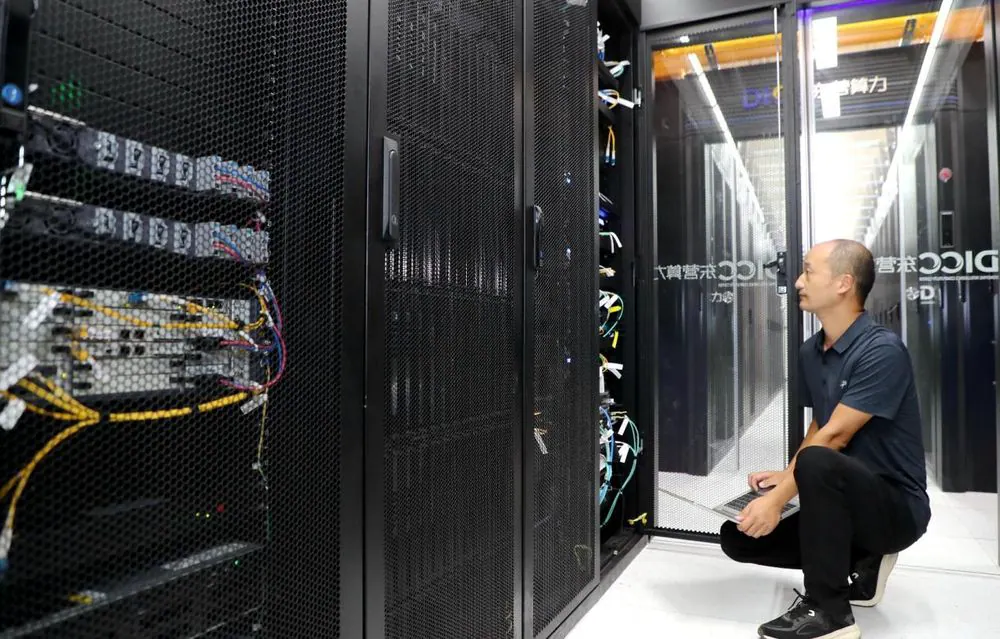
China's intelligent computing capacity has reached 2,185 exaflops (EFLOPS) as of June 2026, with over 70 major computing corridors established nationwide. The Ministry of Industry and Information Technology has set ambitious targets for the 15th Five-Year Plan period, aiming for 9,800 EFLOPS of intelligent computing capacity and 1,700 exabytes of advanced storage capacity by 2030. This represents a more than fivefold and twofold increase, respectively, compared to 2025 baselines.
The rapid growth of artificial intelligence (AI) has driven the demand for computing power, enabling real-world applications such as estimating caloric content from images, optimizing urban mobility, and generating realistic visuals. According to experts, computing power handles data processing, model training, and inference, while storage capacity manages data collection, governance, hosting, and distribution. The synchronization of compute and storage resources can significantly accelerate AI model training, improve inference speed, and enhance output quality.
As of June 2026, China's nationwide utilization rate of computing facilities stood at 71.4%, with total storage capacity reaching about 2,021 exabytes. Advanced storage accounted for around 32% of the total storage capacity. The development of intelligent computing clusters, chips, and interconnectivity is crucial to meet the growing demand for ultra-scale parallel training as model complexity rises.
China plans to deploy high-speed transmission technologies of 400G and above to improve major computing-power corridors connecting national computing hubs. The plan also promotes the integrated development of computing and energy systems, aiming to build green, low-carbon infrastructure that reduces operational costs while supporting national decarbonization goals. Efficient coordination is a key focus of China's development of computing infrastructure during the 15th Five-Year Plan period.
Hebei, Jiangsu, and Guangdong provinces, along with Shanghai and Beijing, rank among the top regions nationwide in overall computing capacity. However, regional development remains uneven, and deeper integration of computing power with industry-specific applications is still needed. Cross-regional allocation of computing resources faces multiple constraints in practice.
Over the next five years, China will build a multi-level computing infrastructure system covering hubs, regions, and the edge. The plan aims to improve the interconnected network architecture linking computing facilities, enhance the efficiency of long-distance, cross-regional lossless network transmission between hubs, and fully connect computing platforms across the country. This is expected to significantly improve the efficiency with which data resources are utilized.
The growth targets for intelligent computing capacity and advanced storage capacity are set to meet the medium- and long-term development needs of China's AI models and digital industries. As of June 2026, China had completed the filing process for 988 generative AI services. The demand for computing power and data storage is steadily increasing, driving the need for a robust computing foundation to support the development and industrial application of various models.
Key points
- China aims to boost intelligent computing capacity to 9,800 EFLOPS and advanced storage capacity to 1,700 exabytes by 2030.
- The country has established over 70 major computing corridors nationwide, with a nationwide utilization rate of computing facilities at 71.4% as of June 2026.
- China plans to deploy high-speed transmission technologies of 400G and above to improve major computing-power corridors connecting national computing hubs.