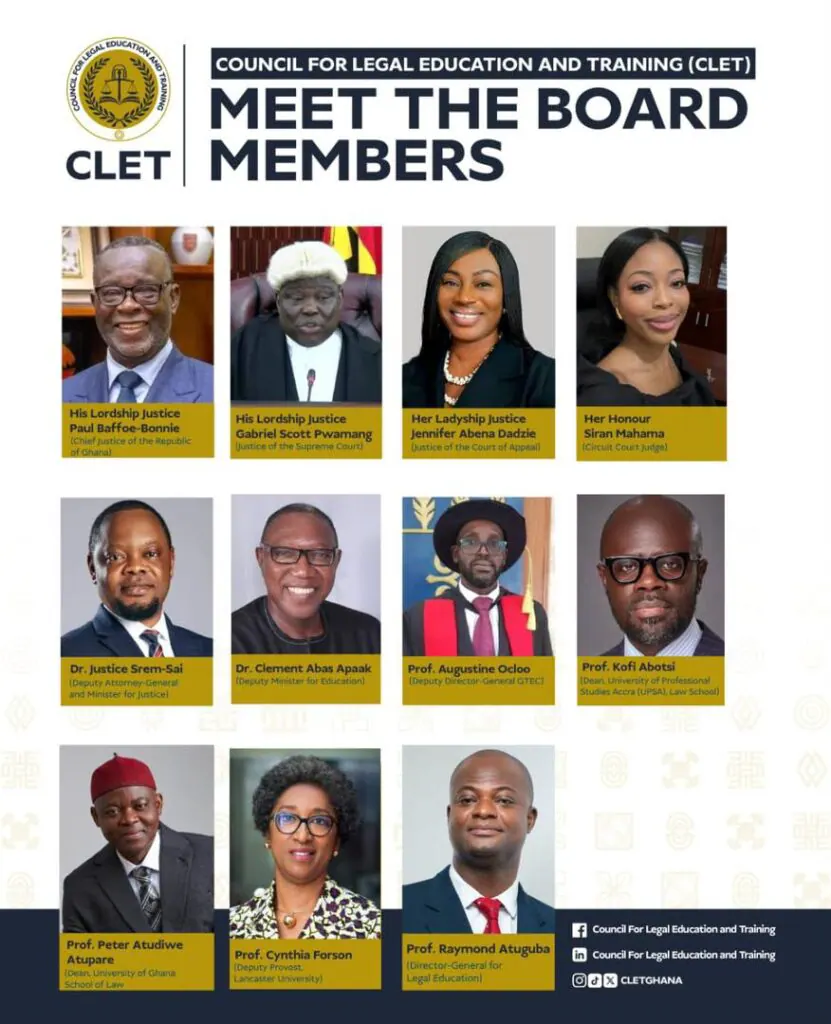
The Council for Legal Education and Training has established its new 11-member Board, with Chief Justice Paul Baffoe Bonnie appointed as its chair. The board oversees Ghana's evolving legal education and professional training system. The newly formed board comprises senior judicial officers, government representatives, tertiary education administrators, and prominent legal academics. This broad institutional representation aims to regulate and develop legal education in Ghana.
The board members include Supreme Court Justice Gabriel Scott Pwamang, Court of Appeal Justice Jennifer Abena Dadzie, and Circuit Court Judge Siran Mahama. Government representatives on the board are Dr. Justice Srem Sai, Deputy Attorney General and Minister for Justice, and Dr. Clement Abas Apaak, Deputy Minister for Education. Additionally, Prof. Augustine Ocloo, Deputy Director General of the Ghana Tertiary Education Commission, is a member.
The academic community is represented by Prof. Kofi Abotsi, Dean of the University of Professional Studies, Accra Law School; Prof. Peter Atudiwe Atupare, Dean of the University of Ghana School of Law; Prof. Cynthia Forson, Deputy Provost of Lancaster University; and Prof. Raymond Atuguba, Director General for Legal Education. The board's composition reflects the multidisciplinary structure of Ghana's new legal education regime.
The establishment of the board is a significant step in implementing the Legal Education Act, 2026, Act 1170. This act created the Council for Legal Education and Training as the institution responsible for regulating professional legal education and establishing standards and curricula for legal training in Ghana. The Council will oversee accreditation of institutions, development and review of legal education curricula, monitoring of academic standards, and administration of professional legal training.
The new framework marks a transition from the previous system, where professional legal education was largely concentrated within the Ghana School of Law. The legislation provides for accredited institutions to participate in professional legal training, subject to meeting the required standards and obtaining necessary approval. The Ghana School of Law has issued transitional directives in preparation for the implementation of the reforms.
The transitional framework provides for eligible LLB graduates to undertake a Pre-Bar Course before progressing to the Law Practice Training programme at an accredited institution. Universities may enter into arrangements with the Ghana School of Law during the transition if they are unable or unwilling to provide particular components of the new training structure.
With the constitution of the CLET board, attention now turns to the practical implementation of the new legal education architecture and the establishment of regulatory mechanisms for accreditation, professional training, curriculum standards, and quality assurance. The board will play a central role in translating the provisions of the Legal Education Act into an operational framework guiding the next phase of professional legal education and training in Ghana.
Key points
- Chief Justice Paul Baffoe Bonnie chairs the new 11-member Council for Legal Education and Training Board.
- The Council will oversee accreditation of institutions, development and review of legal education curricula, and administration of professional legal training.
- The new framework provides for accredited institutions to participate in professional legal training, subject to meeting required standards.