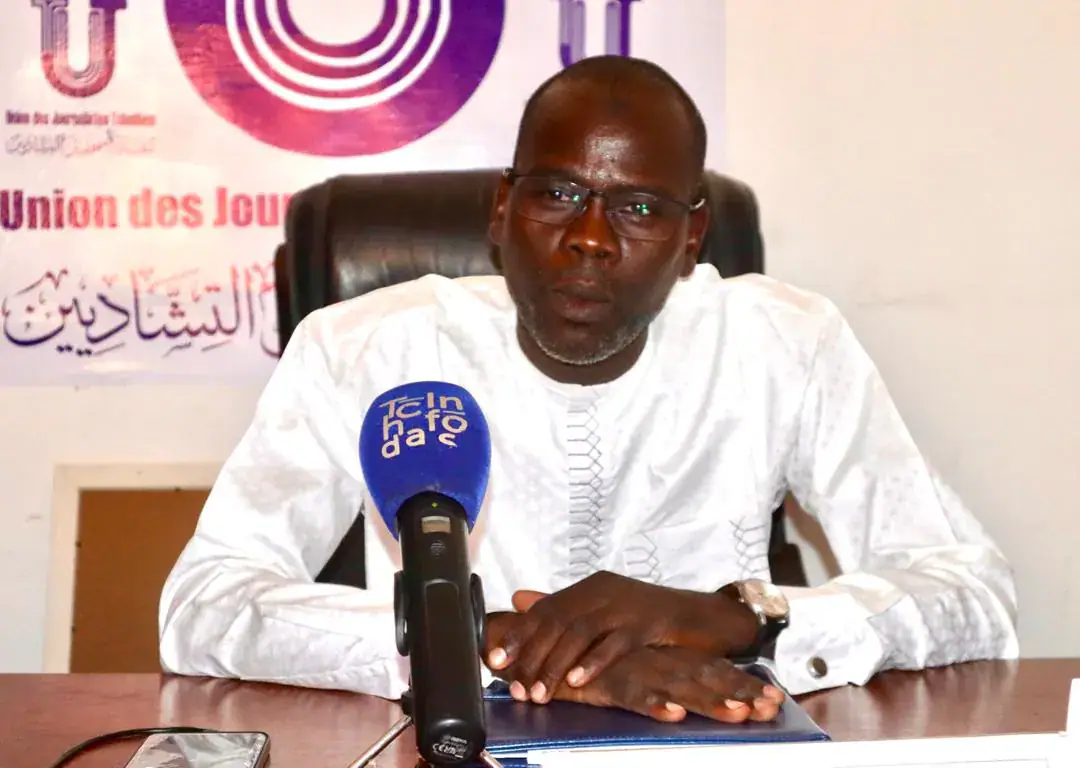
On November 2, 2026, the International Day to End Impunity for Crimes against Journalists, Abbas Mahamoud Tahir, president of the Chadian Journalists' Union (UJT), emphasized the need to strengthen security for media professionals in Chad and globally. This day, established by the UN in 2013, honors journalists killed or intimidated while doing their job. Tahir highlighted the threats, intimidation, and harassment faced by journalists, which hinder their role and directly impact press freedom.
The UJT has been working to establish a specific legal framework to protect journalists in Chad. A proposed law on journalist protection and safety was submitted to the National Transitional Council, and the union has since engaged in multiple advocacy efforts. Recently, a UJT delegation met with the National Assembly's Communication and New Technologies Commission to persuade lawmakers to adopt the text. Tahir stressed that having a protective legal framework would be a significant progress for journalists.
Beyond legislative advocacy, the UJT conducts awareness and training actions. With UNESCO support, workshops were organized in N'Djamena, Moundou, and Abéché on relations between journalists and defense and security forces. Training sessions on journalist safety were also held with the International Federation of Journalists (IFJ) at the Maison des médias. The UJT collaborates with security authorities, including designating a focal point within the National Police to facilitate coordination and protection.
Tahir recalled several unresolved cases illustrating persistent impunity, including the disappearance of Noubadoum Sotinan in Cameroon 13 years ago and the 2022 assassination of Narcisse Orédjé. He also mentioned regional cases like Moussa Kaka (Niger), Martinez Zogo (Cameroon), and Norbert Zongo (Burkina Faso). Some Chadian journalists still face threats or are forced to live in hiding.
The UJT president emphasized the responsibility of journalists themselves, particularly during demonstrations or unrest. Clear identification, such as wearing vests, badges, or distinctive signs, can prevent confusion with protesters. Tahir called on his colleagues to show solidarity in the fight against impunity, which he considers essential for democracy.
Tahir highlighted the importance of press freedom, which he believes is a fundamental condition for democracy. Without security for journalists, this freedom remains fragile. The UJT continues to engage in advocacy, awareness-raising, and dialogue with authorities to protect journalists and combat impunity.
The UJT's efforts aim to ensure that journalists can perform their duties without fear of violence or intimidation. Tahir concluded by emphasizing the need for collective action to protect journalists and promote press freedom, which is essential for a functioning democracy.
Key points
- The Chadian Journalists' Union is pushing for a law to protect and ensure the safety of journalists.
- Impunity for crimes against journalists persists in Chad and globally.
- The UJT is conducting awareness and training actions to promote journalist safety.