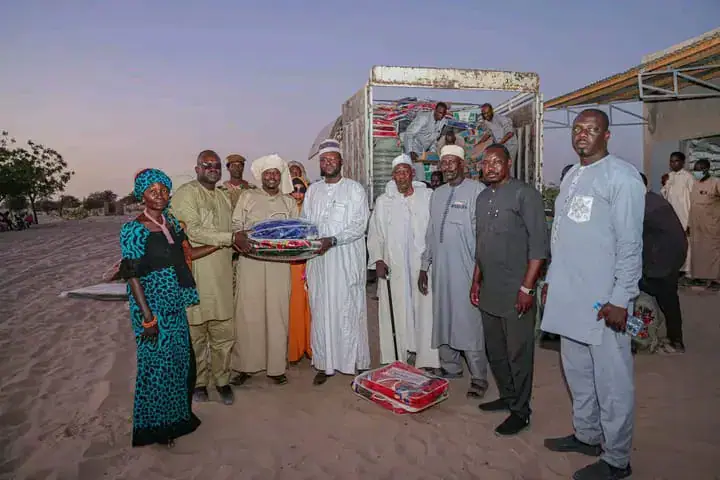
A delegation from Chad's Ministry of Social Action, National Solidarity and Humanitarian Affairs led by Moustapha Mahamat Adji, delivered 125 kits of food and non-food items to the prefect of Lac province, Ahmat Adoum Seid, on November 9, 2026. The kits, which include macaroni, sugar, dates, soap, mattresses, jugs, buckets and blankets, were made possible with support from the National Fund of Solidarity and Support to Vulnerable Persons. The handover ceremony took place in the presence of local authorities and medical officials.
The cholera outbreak in Chad, declared in mid-June 2026, has spread to Lac province, with districts of Bol, Kangallom, Bagassola and Liwa reporting a significant number of new cases. As of October 30, 2026, the country had recorded 1,431 cases, according to a regional meeting on the Lake Chad basin. The epidemic is not limited to Chad, as the same strain is circulating in Cameroon and Nigeria. The crisis has been exacerbated by insecurity in the region, with a rise of 80% in incidents between January 2024 and April 2026.
The humanitarian situation in Lac province is dire, with around 60,000 people displaced due to repeated attacks and military operations. Official data shows that the province has 219,000 internally displaced persons, and over 78% of children are out of school. A 2025 protection report described the situation as a "forgotten crisis," marked by high socio-economic vulnerability and limited access to arable land due to water bodies.
The aid kits aim to address immediate needs, particularly hygiene and water, which are crucial in preventing the spread of cholera. However, the 125 kits are considered modest given the scale of vulnerability in the province, which has hundreds of thousands of people in need. It is unclear how many households or villages will be served by the kits.
Containing the cholera epidemic requires sustainable efforts, including access to potable water, sanitation, equipped health centers and a stable humanitarian presence. The UNHCR has warned that the humanitarian response is not keeping pace with needs. Despite this, the Chadian government has expressed ambition to articulate emergency aid with development policies, strengthening basic services in health, education, water and infrastructure.
The situation in Lac province is complex, with insecurity, displacement, climate change and epidemic converging. The government has announced plans to ensure that humanitarian aid is aligned with long-term development strategies, with measurable results. The solidarity efforts, though, need to be part of a durable strategy with visible follow-up.
The distribution of aid kits is a temporary solution to a broader crisis. Long-term solutions require substantial investment in infrastructure, healthcare and education. The Chadian government's efforts to address the humanitarian crisis, though laudable, face significant challenges, including limited resources and a complex operating environment.
Key points
- The Chadian government distributed 125 aid kits to Lac province, which is struggling with a cholera outbreak and humanitarian crisis.
- The province has 219,000 internally displaced persons and over 78% of children out of school.
- The humanitarian response to the crisis is not keeping pace with needs, according to the UNHCR.