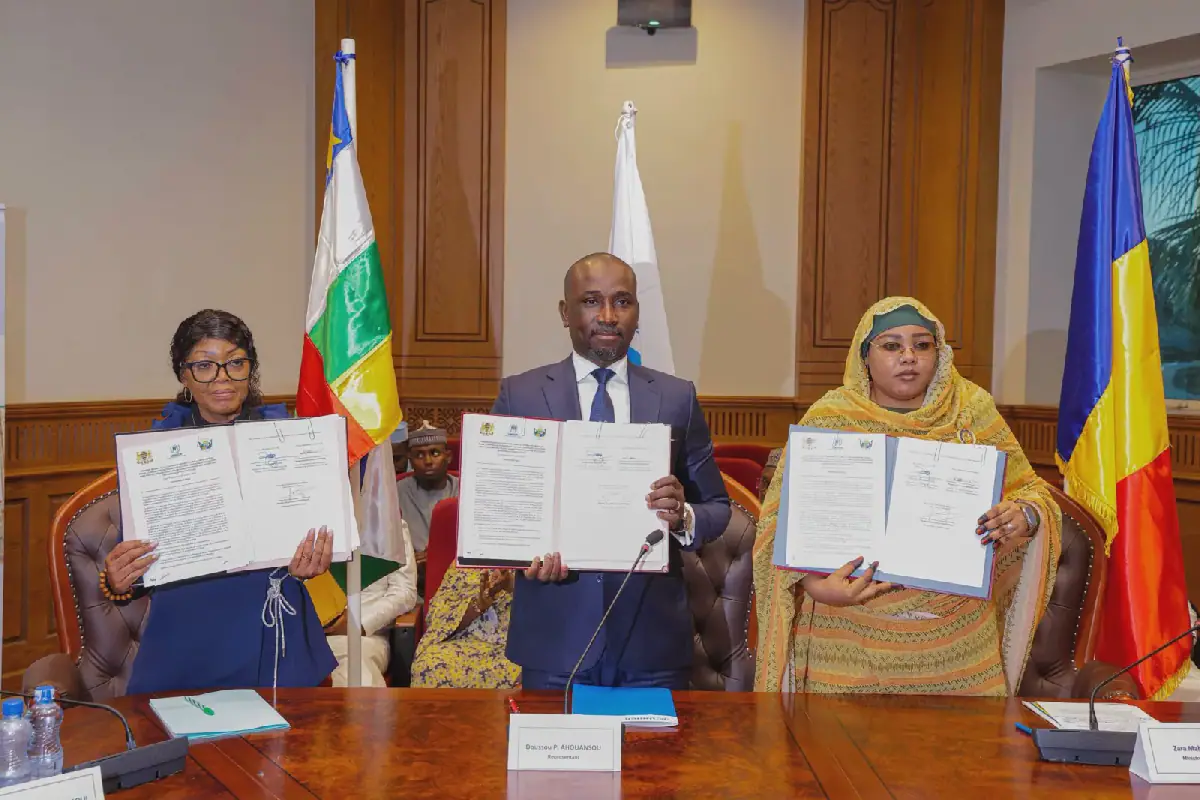
The Chadian Minister of Social Action, National Solidarity, and Humanitarian Affairs, Zara Mahamat Issa, officially closed the tripartite commission meeting between Chad, the Central African Republic (CAR), and the United Nations High Commissioner for Refugees (UNHCR) on November 4, 2026. The meeting resulted in the adoption of a final communiqué and the signing of tripartite agreements outlining the modalities for the voluntary return of refugees to CAR. The ceremony was attended by government members, diplomats, and technical and financial partners.
The discussions led to the validation of practical modalities for voluntary repatriation, the adoption of an operational schedule, and the internal regulations of the tripartite commission. The parties reaffirmed their commitment to ensuring a free, secure, and dignified return for refugees, while promoting their sustainable reintegration in CAR, with the support of the UNHCR and concerned partners. This meeting was organized in line with the common desire of the Chadian and Central African governments, with UNHCR support, to establish a concertation and cooperation framework.
The agreement aims to operationalize the tripartite accord on the voluntary repatriation of Central African refugees living in Chad, signed on October 22, 2024, in Bangui. It also aligns with regional commitments to durable solutions for forcibly displaced Central African people, including the action plan adopted during the ministerial meeting in Brazzaville in February 2025. Several preparatory steps preceded this tripartite commission meeting, including the official launch of operational activities in Goré on March 27, 2026.
A transborder meeting between Chad and CAR took place, bringing together the Chadian National Commission for the Reception and Reintegration of Refugees and Repatriates (CNARR), the CAR National Commission for Refugees (CNR), and the UNHCR. Additionally, a reconnaissance visit to return areas was organized from September 14 to 17, 2026. A technical preparatory meeting of experts was held in Bangui on September 28-29, 2026, and technical working group meetings took place on October 28-30, 2026.
These meetings aimed to update the documents submitted for the tripartite commission's examination. In the final communiqué, the parties praised the generosity and constant commitment of the Chadian government and people, who have provided protection and assistance to Central African refugees for many years. They also acknowledged progress made in CAR, including consolidation of peace, stabilization, national reconciliation, and recovery in several regions.
The parties noted the initiatives undertaken to facilitate the return and reintegration of displaced populations. The signing of these agreements marks a significant step towards enabling the safe and dignified return of Central African refugees. The implementation of the voluntary repatriation plan will require close collaboration between the governments of Chad and CAR, the UNHCR, and other stakeholders.
The tripartite commission's work reflects a commitment to finding durable solutions for refugees and promoting regional cooperation. Key aspects of the agreements include ensuring the voluntary nature of repatriation, providing secure and dignified return conditions, and supporting the reintegration of returnees in CAR.
Key points
- The tripartite agreements define the modalities for the voluntary return of Central African refugees living in Chad.
- The parties have reaffirmed their commitment to ensuring a free, secure, and dignified return for refugees.
- The agreements align with regional commitments to durable solutions for forcibly displaced Central African people.