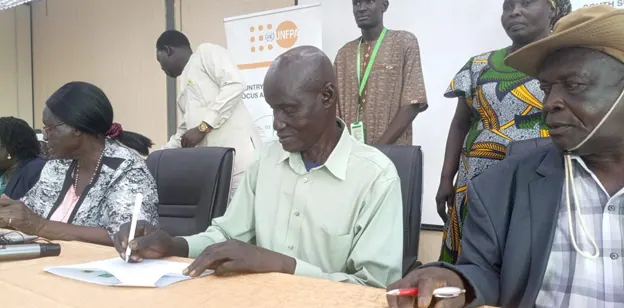
Traditional chiefs from Central Equatoria State have made a strong commitment to intensify community efforts to end child marriage and strengthen the protection of girls across the state. The commitment was signed on Wednesday after a two-day chiefs' conference in Juba, where traditional leaders agreed to collaborate with families, government institutions, civil society, and women's and youth organizations to prevent child marriage and safeguard girls from harmful practices.
The Director General in the Central Equatoria State Ministry of Gender and Child Social Welfare, Nunu Diana, emphasized the need for collective action involving traditional leaders, government, civil society, and youth and women-led organizations. She noted that traditional leaders have an important role to play in protecting the rights, dignity, health, and future of children. Diana highlighted the continuing challenges facing communities, citing her interactions with communities earlier this year.
Diana recounted a visit to Mugo in Yei River County, where she spoke to 10 girls aged between 13 and 15 in a market, all of whom were already mothers and not attending school. She also observed many young girls selling milk along the streets in Terekeka, appearing to be girls who should still be in school. These experiences underscored the practical evidence of the challenges confronting girls across Central Equatoria state.
Joseph Brown, the representative of paramount chiefs in Central Equatoria state, called for continued community sensitization and cooperation among traditional leaders, government, and other stakeholders. He stated that the engagement places traditional leaders at the center of community-led efforts to address harmful social practices, promote girls' education, and support marriage only when individuals have reached adulthood.
Regina Lullo, the Director General in the National Ministry of Gender, Child and Social Welfare, stressed that progress in one county alone would be insufficient unless communities across Central Equatoria collectively addressed the practice of child marriage. She urged traditional leaders across Central Equatoria state to leverage their influence within communities to raise awareness, prevent child marriage, and support young girls in remaining in school.
The two-day chiefs' conference reviewed the implementation of the Traditional Authority 2026 Resolution Action Plan, which falls under the 2017–2030 Strategic National Action Plan on Ending Child Marriage in South Sudan. The conference was supported by Amref Health Africa and the United Nations Population Fund (UNFPA) as part of ongoing efforts to engage traditional leaders in tackling harmful practices and protecting children's rights.
The commitment made by traditional chiefs in Central Equatoria State is a significant step towards ending child marriage and protecting girls in the region. With the support of government institutions, civil society, and women's and youth organizations, traditional leaders are poised to play a crucial role in promoting girls' education and preventing child marriage.
Key points
- Traditional chiefs in Central Equatoria State have signed a comprehensive commitment to end child marriage and protect girls.
- The commitment was made after a two-day conference in Juba, where traditional leaders agreed to collaborate with stakeholders to prevent child marriage and safeguard girls.
- The effort is part of the 2017–2030 Strategic National Action Plan on Ending Child Marriage in South Sudan, supported by Amref Health Africa and the United Nations Population Fund (UNFPA).