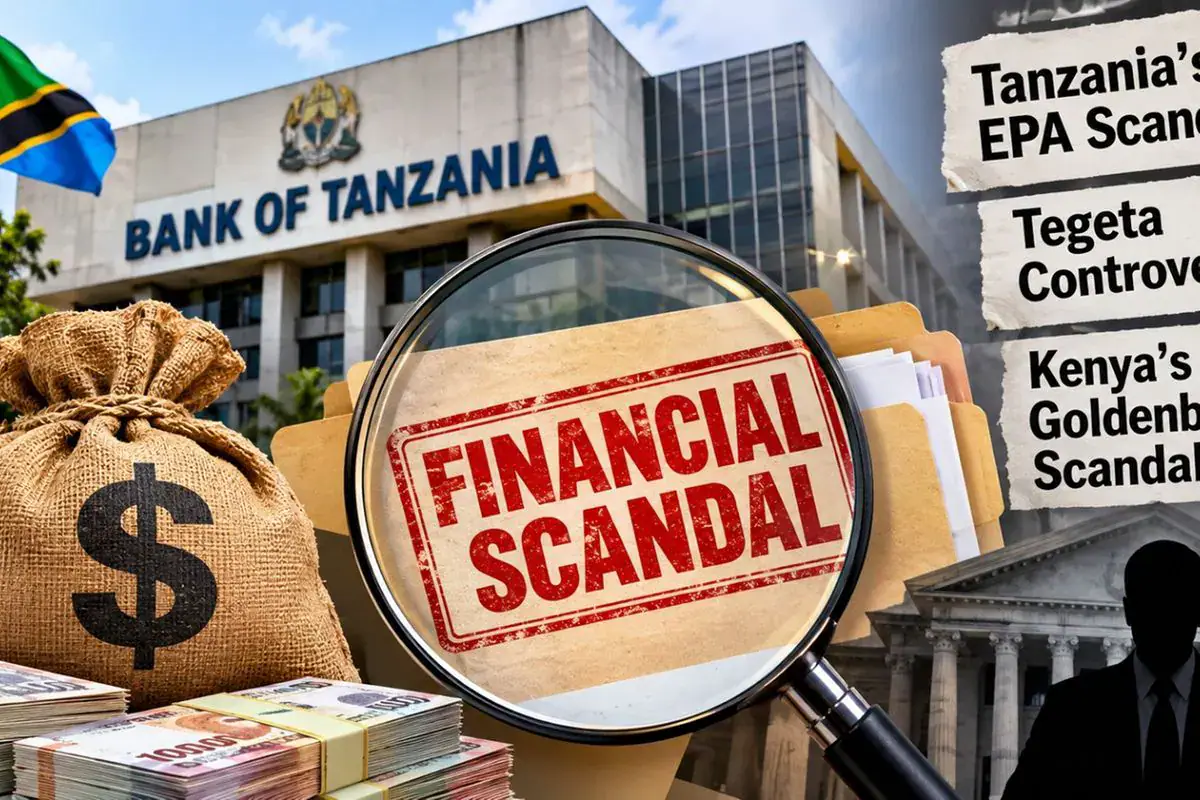
Central banks play a critical role in managing monetary policy, overseeing the financial system, and maintaining international reserves. However, East African history has seen troubling examples of scandals involving central-bank accounts and government financial transactions. Tanzania's External Payment Arrears (EPA) scandal, the Tegeta escrow controversy, and Kenya's Goldenberg affair demonstrate the importance of protecting public financial institutions from improper influence. These institutions must be governed by law, transparent accounting procedures, and strong internal controls.
Tanzania's EPA scandal involved the External Payment Arrears account at the Bank of Tanzania, which was used to settle outstanding foreign-payment obligations. A special audit by Ernst & Young identified serious irregularities, revealing that approximately Sh133 billion, equivalent to about $113 million, was paid to 22 local companies on the basis of fraudulent or unsupported documentation. This scandal exposed weaknesses in institutions expected to protect national resources. The International Monetary Fund's 2008 assessment highlighted the need for stronger oversight and accountability.
Another major controversy in Tanzania emerged in 2014 involving approximately Sh306 billion held in the Tegeta escrow account at the Bank of Tanzania. The account arose from a dispute concerning electricity capacity charges under arrangements between Tanesco and Independent Power Tanzania Limited. Parliament's Public Accounts Committee challenged the legality of aspects of the transactions, raising serious concerns about corporate ownership, due diligence, possible lost public revenue, and the responsibilities of senior officials.
Kenya's Goldenberg scandal provides another instructive example of the risks of financial mismanagement. The scandal arose from arrangements intended to encourage exports of gold and diamonds during the early 1990s. A Judicial Commission of Inquiry chaired by Justice Samuel Bosire examined questionable payments, financial transactions, and the involvement of public and private officials. Allegations also concerned the knowledge and possible involvement of former President Daniel arap Moi.
These scandals raise fundamental questions about financial governance. Were payment instructions supported by valid legal authority? Did independent officials verify the claims and ownership arrangements? Could a central-bank official refuse instructions considered unlawful? Did Parliament obtain the necessary information to investigate? Were audit recommendations implemented? These questions highlight the need for stronger institutional design and integrity of officials entrusted with oversight reporting.
The Tegeta Escrow scandal illustrates the importance of transparency and accountability. While recipients of funds through Mkombozi Bank were publicly identified, questions remained over the identities of those who received substantial cash withdrawals through another bank. This highlights the need for comprehensive and transparent investigations, including the recovery of questionable payments and the identification of ultimate beneficiaries.
The most dangerous condition arises when public officials believe that instructions attributed to senior political leaders must be obeyed even where legal procedures demand otherwise. A central bank must never become an informal source of discretionary resources available through political influence. Financial controllers, auditors, and professional officials should be able to discharge their legal responsibilities without fear of retaliation.
Key points
- Central banks must be protected against improper influence to safeguard national finances.
- Financial scandals in Tanzania and Kenya highlight weaknesses in institutions entrusted with national finances.
- Stronger institutional design and integrity of officials are necessary to prevent financial mismanagement.