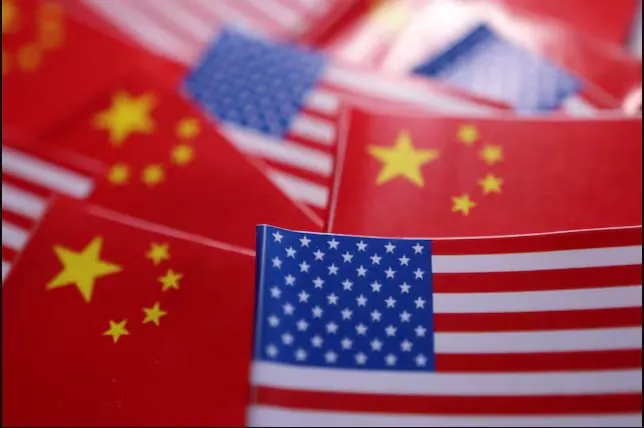
The United States is preparing to inform dozens of partner countries that they may have to take a clearer stance on cooperation in artificial intelligence with either the US or China. This move comes as global technological competition between the two nations intensifies. A draft letter from the US State Department, seen by Reuters, warns that countries may not be able to participate in both the US-led Pax Silica initiative and a competing Chinese initiative on artificial intelligence.
The issue concerns 35 countries that signed the American AI Opportunity Statement adopted in June. The draft letter highlights that these countries may face growing pressure over their choice of technology partners as AI becomes increasingly connected to critical sectors such as semiconductor manufacturing, energy, and national security. Central Asian countries, in particular, will have to navigate this complex landscape.
It is unrealistic to expect Central Asian countries to abandon their multi-vector foreign policies and choose one technology ecosystem at the expense of the other. The US views AI not just as an economic sector but as a strategic technology ecosystem that includes advanced semiconductors, computing capacity, and data centers. From Washington's perspective, a country's participation in China-linked initiatives may raise questions that go beyond AI regulation.
The US and Chinese approaches to AI cooperation differ significantly. Pax Silica focuses on securing critical technology supply chains, while the Chinese initiative, WAICO, emphasizes building national capacity, international AI governance, and access to technology. The American approach can be described as "secure the technology ecosystem," while the Chinese approach is more focused on "expand access to the technology ecosystem."
For countries in the Global South, including those in Central Asia, the Chinese approach is particularly attractive. China provides infrastructure, equipment, AI models, training, and technology platforms, gaining clear strategic advantages. The wider use of Chinese technologies also helps spread Chinese standards, products, and institutional practices. Independent research highlights the dual nature of WAICO, which may strengthen China's international influence while responding to a genuine demand from developing countries.
The AI race is entering a new phase, with China competing with the US in performance, cost, and scale of deployment. According to Stanford HAI, the gap between leading American and Chinese AI models was only 2.7% in March 2026. China is strengthening its position through open-weight models, rapid development, and lower operating costs. The US still has major advantages, but China's strategy is different, focusing on making advanced AI cheap, accessible, and widely available.
Central Asian countries, such as Kazakhstan and Uzbekistan, have traditionally based their foreign policy model on diversification rather than exclusive alignment with a single external partner. Their goal is to avoid excessive dependence on any one external power while attracting investment, technology, and access to different markets. This approach is particularly rational in the technology sector, where building competitive AI infrastructure requires substantial financial investment, access to advanced technologies, and integration into global technology chains.
Key points
- The US is set to tell partner countries they may have to choose between American and Chinese approaches to AI cooperation.
- Central Asian countries face growing pressure over their choice of technology partners as AI becomes increasingly connected to critical sectors.
- The US and Chinese approaches to AI cooperation differ significantly, with the US focusing on securing critical technology supply chains and China emphasizing building national capacity and access to technology.