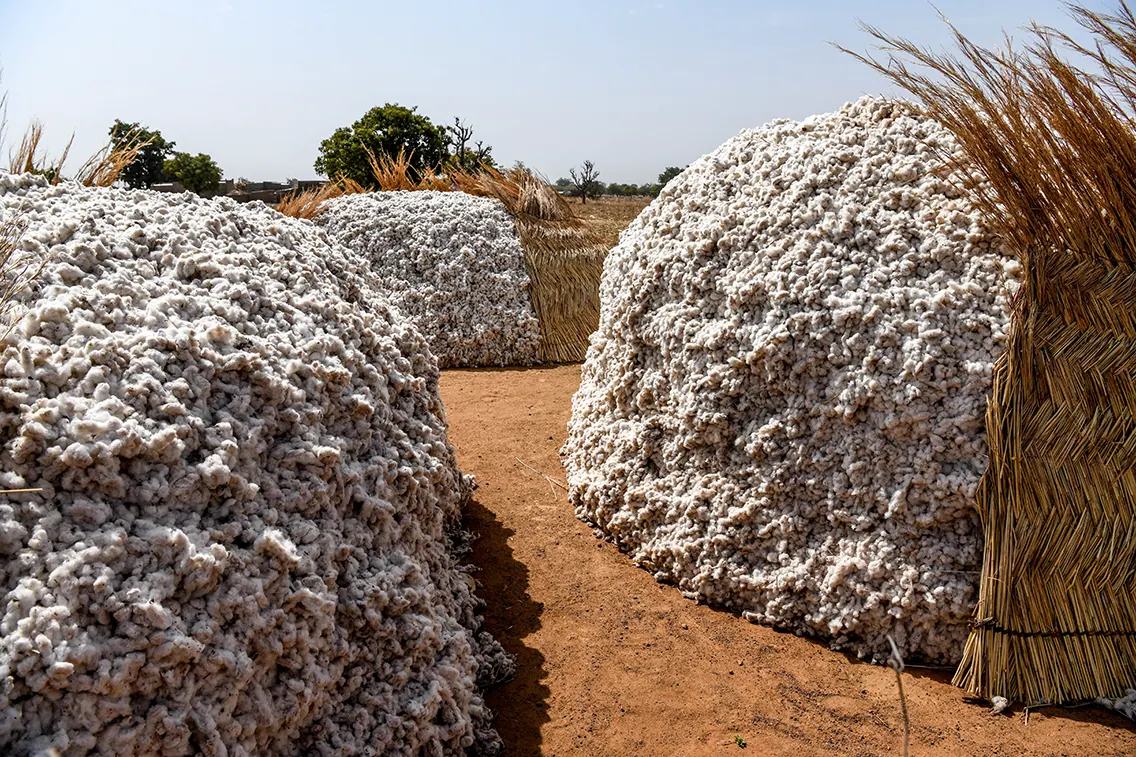
As World Cotton Day approaches on October 7, 2026, attention is turning to how Africa can develop a more integrated cotton and textile industry. The occasion recognises the work of the millions of farmers and textile workers employed in the industry, while drawing attention to the specific challenges facing developing countries that seek a greater share of the industry's total value. Cotton is one of Africa's most important cash crops, particularly in West and Central Africa, where millions of smallholder farmers depend on it.
The crop is grown commercially in more than 70 countries and supports the livelihoods of an estimated 100m families worldwide. The International Cotton Advisory Committee (ICAC) estimates global cotton lint production at 26.5m tonnes in the 2025/26 season, with Africa accounting for roughly 1.5-1.7m tonnes. China, India and Brazil are among the world's biggest producers, while Brazil and the US dominate international exports.
According to US Department of Agriculture estimates for the 2025/26 season, Benin is Africa's biggest cotton producer, with output of about 250,000 tonnes of lint, followed by Mali (179,000t), Burkina Faso (139,000t), Côte d'Ivoire (122,000t) and Cameroon (115,000t). Egypt is not one of the biggest producers but holds an important position through its premium long-staple and extra-long-staple varieties.
Across much of Sub-Saharan Africa, production is concentrated among smallholders cultivating relatively small plots, often alongside food crops. African production is particularly vulnerable to fluctuations in rainfall, pest infestations, insecurity and changing international prices. In Mali, Burkina Faso and elsewhere, cotton is also closely integrated into wider agricultural systems, with farmers using income from the crop to finance food production, agricultural equipment and household expenditure.
Securing a fairer price for raw cotton would enable African producers to retain a greater proportion of cotton's overall value. As a result, Benin, Burkina Faso, Chad and Mali established the Cotton-4 (C4) coalition in 2003 to campaign for fairer conditions in global cotton markets, particularly the reduction of trade-distorting agricultural subsidies in developed economies. Côte d'Ivoire subsequently joined the group, which is now known as Cotton-4+ (C4+), with the coalition continuing to advocate for improved market conditions and greater support for African cotton producers.
The missing links in the value chain are a major challenge for African cotton producers. After harvesting, African seed cotton is sent to ginning facilities, where the fibres are separated from the seeds and compressed into bales. However, the continent plays a very limited role in the next stages of production: spinning yarn, weaving or knitting fabric, dyeing, finishing and garment manufacturing. Indeed, according to World Trade Organization figures published in March 2026, about 98% of West and Central African cotton is exported as raw fibre.
To address this challenge, Afreximbank has launched the Africa Textile Renaissance Plan, backed by a proposed $5bn financing programme. The initiative aims to establish the capacity to process and utilise 500,000 tonnes of African cotton within the continent by 2029, creating up to 500,000 jobs, including in textile manufacturing, transport and fashion design, in the process. The African Continental Free Trade Area (AfCFTA) also provides an opportunity to transform the industry by encouraging the emergence of regional cotton and textile supply chains.
Key points
- African cotton producers are seeking to develop a more integrated cotton and textile industry to capture a greater share of the industry's total value.
- The Africa Textile Renaissance Plan aims to establish the capacity to process and utilise 500,000 tonnes of African cotton within the continent by 2029.
- The African Continental Free Trade Area (AfCFTA) can encourage the emergence of regional cotton and textile supply chains.