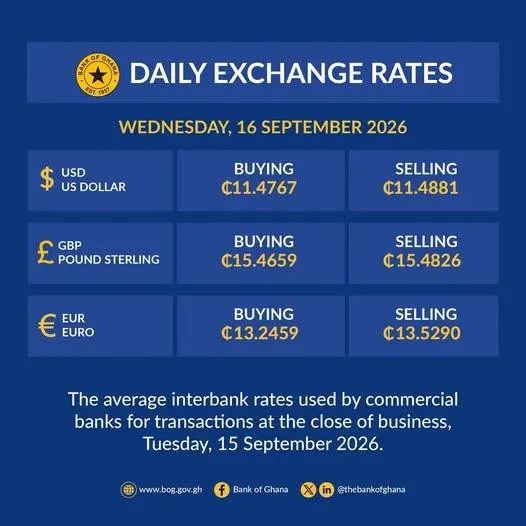
The Ghanaian cedi experienced a significant decline in value against the US dollar during the second quarter of 2026. According to the World Bank's October 2026 Africa Economic Update, the cedi lost almost 10% of its value against the dollar between March and June 2026. This depreciation was the sharpest of any African currency during that period. The World Bank attributed the pressure on the cedi to the escalation of conflict in the Middle East, which triggered broad-based currency depreciation across Africa.
The cedi's decline was part of a broader trend affecting several African currencies. The World Bank reported that seven African currencies, including Ghana's, saw their maximum depreciation exceed 5% relative to levels recorded at the end of February 2026. The currencies that weakened significantly included those of the Democratic Republic of Congo, the Seychelles, and South Africa. The World Bank explained that the spike in oil and energy prices linked to the Middle East escalation pushed up import bills for net energy-importing economies like Ghana.
The depreciation of the cedi had significant implications for Ghana's economy. A weaker cedi raises the local-currency cost of anything priced in dollars, including fuel, imported food, medicines, and raw materials for businesses. The World Bank's analysis linked the currency slide directly to rising oil and energy import costs and higher prices for imported agricultural inputs like fertiliser. This typically filters through to pump prices and the cost of staple foods.
Despite the currency turmoil, Ghana's economy demonstrated resilience, growing 4.8% in 2026. The World Bank forecasts 4.9% growth for 2027. The growth was driven by the services sector, a recovery in oil and gas activity, and the continued effects of structural and fiscal reforms tied to national programmes. In the second quarter of 2026, real GDP grew 6.0% year-on-year, a slowdown from the 6.6% recorded in the same quarter of 2025.
The services sector remained the biggest driver of growth, expanding 8.0% and accounting for nearly three-fifths of overall GDP growth. Information and communications technology activity rose 30.9%. Industry strengthened to 4.3% growth, up from 2.4% a year earlier, helped by a jump in oil and gas production. However, agriculture growth slowed sharply to 3.9% from 7.1%, due to a steep contraction in fishing activity.
The World Bank's report also highlighted the uneven momentum in Ghana's economy. Investment surged by 53.0%, and overall domestic demand rose 11.2%, indicating continued strength in both private and public spending. However, the headline GDP growth figures do not automatically translate into lower prices at the market or petrol station. The growth remained concentrated in services, ICT, and hydrocarbons, while momentum weakened elsewhere in the economy, including in agriculture.
The World Bank's Africa Economic Update is a twice-yearly flagship report that tracks economic performance across African countries and provides policy analysis and forecasts. The report placed Ghana's performance in a regional context, with growth across the West and Central Africa subregion projected to hold steady at 4.5% in 2026. The sources reviewed do not specify any scheduled government or Bank of Ghana response to the Q2 currency pressures, nor do they give a timeline for when the cedi might stabilise further.
Key points
- The cedi's near-10% depreciation against the dollar between March and June 2026 was the sharpest slide of any African currency during that period.
- Ghana's economy grew 4.8% in 2026, driven by the services sector, a recovery in oil and gas activity, and structural and fiscal reforms.
- The depreciation of the cedi had significant implications for Ghana's economy, including higher import costs and inflationary pressures.