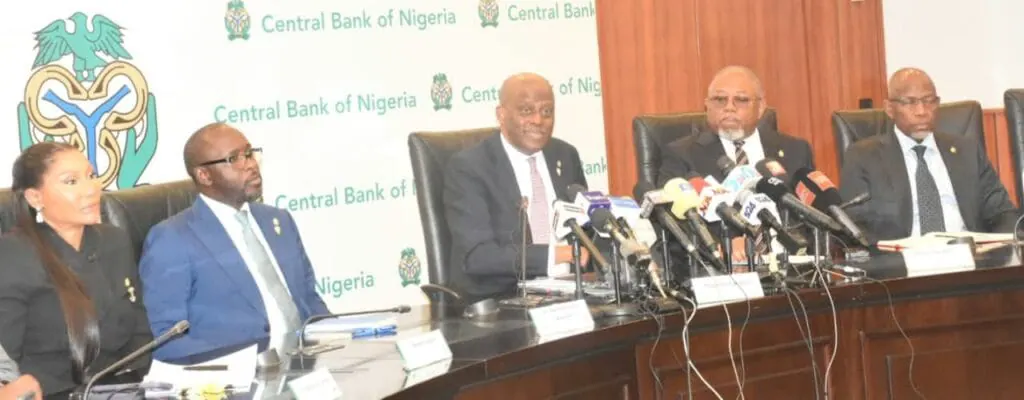
The Central Bank of Nigeria (CBN) has reset its Monetary Policy Rate (MPR) to 23 per cent from 26.5 per cent, a move welcomed by experts and industry players. This decision was made at the 307th meeting of the Monetary Policy Committee (MPC), held on September 21 and 22, 2026. The CBN Governor, Olayemi Cardoso, announced that the Committee also recalibrated the Standing Facilities Corridor to +50/-300 basis points around the MPR.
The MPC emphasized that the reset of the benchmark rate is not a change in its underlying tightening stance. The recalibration aims to strengthen monetary policy transmission and restore the primacy of the MPR as the key signal of the Bank’s policy direction. A widening gap had emerged between the MPR and prevailing market rates, weakening the effectiveness of monetary policy transmission across the economy.
The CBN's ongoing repair of its policy implementation framework has improved transparency in money market operations. The introduction of the Nigerian Overnight Funding Rate (NOFR) as a transaction-based operational benchmark has contributed to this improvement. The MPC noted that the timing of the reset is appropriate, supporting Nigeria’s gradual transition toward an inflation-targeting framework.
The current macroeconomic environment gives the CBN confidence to proceed without derailing the disinflation process. Headline inflation slowed to 15.39 per cent in August 2026, down slightly from 15.43 per cent in July. Food inflation eased to 19.57 per cent in August from 20.31 per cent the previous month, driven by falling prices of palm oil, vegetables, and meat.
The MPC linked the disinflation trend to the lagged effects of earlier monetary tightening, exchange rate stability, and improving inflation expectations. Real Gross Domestic Product (GDP) grew by 4.43 per cent in the second quarter of 2026, up from 3.89 per cent in the first quarter. Both the oil and non-oil sectors contributed to this improvement, with the non-oil sector expanding by 4.31 per cent.
Business sentiment strengthened, with the Composite Purchasing Managers’ Index (PMI) rising to 52.7 index points in August from 51.1 in July. Nigeria’s balance of payments position recorded a surplus of $3.51 billion in the second quarter of 2026, up from $2.38 billion in the first quarter. Gross external reserves stood at $55.25 billion as of September 18, 2026, the highest level in 18 years.
The MPC welcomed two developments that will reinforce the disinflation trend: the Presidential Initiative on the National Affordable CNG Transit Programme and a Memorandum of Understanding between the Federal Ministry of Finance and the CBN on fiscal-monetary coordination. These developments create sufficient headroom to justify the timing of the rate corridor reset.
Key points
- The CBN's decision to reset interest rates aims to support economic growth and stability.
- The reset is not a change in the underlying tightening stance, but rather an operational realignment.
- The CBN projects inflation to moderate further in the short-to-medium term, underpinned by stability in the foreign exchange market and improved food supply.