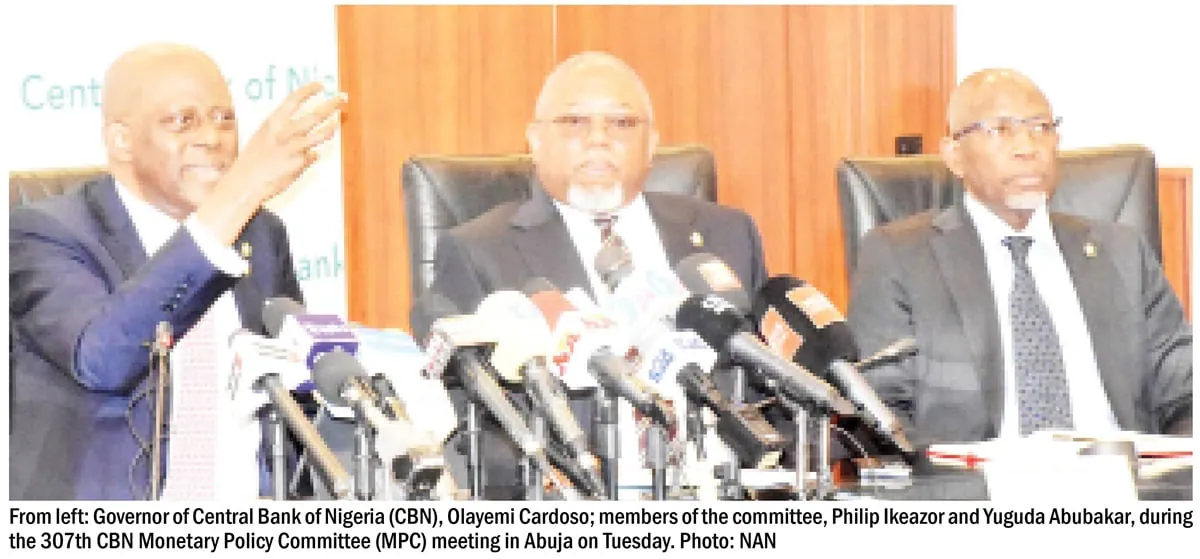
The Central Bank of Nigeria (CBN) has reduced the interest rate from 26.5 percent to 23 percent, effective September 2026. This decision was made during the 307th meeting of the Monetary Policy Committee (MPC) in Abuja. According to CBN Governor, Mr. Olayemi Cardoso, the committee considered recent trends in the global and domestic economic environment, emerging risks, and their potential implications for monetary policy. The MPC also decided to recalibrate the standing facilities corridor to plus 50 to minus 300 basis points around the MPC.
The CBN's decision to cut the interest rate aims to support economic growth by encouraging banks to lend to productive sectors. Economists have welcomed the decision, describing it as a balanced move that could strengthen banking system resilience. The 350-basis-point reduction is expected to reduce borrowing costs, ease government debt-service pressures, and provide businesses and households with greater financial breathing space. Dr. Suleyman A. Ndanusa, a banker, lawyer, and economist, noted that the cut could signal a shift from emergency stabilization towards supporting productive economic activity.
The MPC also retained the cash reserve requirement for deposit money banks at 45 percent, merchant banks at 16 percent, and non-TSA public sector deposits at 75 percent. According to Dr. Ndanusa, this means that banks still face high operating costs, credit risks, and competition from government securities. He emphasized that the real test of the MPC decision would be whether lending rates decline, credit reaches agriculture and manufacturing, and borrowing costs for small businesses fall.
Economists and capital market experts have commended the CBN for the rate cut, describing it as a decisive policy reset. Dr. Mike Onadele, former Director of Bank Examination Department at the Nigeria Deposit Insurance Corporation (NDIC), said the decision was well-judged and timely from a prudential and financial system stability perspective. He noted that the rate cut was particularly significant following the completion of the banking sector recapitalization, which had strengthened banks' capital buffers.
The CBN's decision to recalibrate the standing facilities corridor aims to strengthen monetary policy transmission and reinforce the primacy of the Monetary Policy Committee. According to the MPC, the recalibration does not constitute a change in the current monetary policy stance but rather an operational reset to enhance the effectiveness of monetary policy. The committee emphasized that the current macroeconomic environment remains supportive of such a recalibration without undermining the disinflation process.
Researchers have noted that the significance of the policy would ultimately be measured by its impact on the cost of credit, household purchasing power, employment, and business activity. Dr. Ayinde O. Ayinde, a researcher at Covenant University, said the rate cut could mark the beginning of a broader economic policy coordination framework, particularly against the backdrop of the recent fiscal and monetary policy coordination memorandum between the CBN and the Federal Ministry of Finance.
The CBN's decision to cut the interest rate has elicited optimism from economists and capital markets experts on the positive outlook on economic growth. The reduction in interest rate is expected to encourage lending, support growth, and discourage banks from parking surplus funds with the CBN. However, experts have cautioned that the impact of the rate cut would depend largely on how quickly monetary policy is transmitted to lending rates and the real economy.
Key points
- The CBN has reduced the interest rate from 26.5 percent to 23 percent to support economic growth and encourage lending.
- The decision aims to strengthen banking system resilience and provide businesses and households with greater financial breathing space.
- The impact of the rate cut would depend largely on how quickly monetary policy is transmitted to lending rates and the real economy.